

Jian
Updated: Sep 29
MEANING: Jiān
PERIOD: Early Cretaceous
CONTINENT: Asia
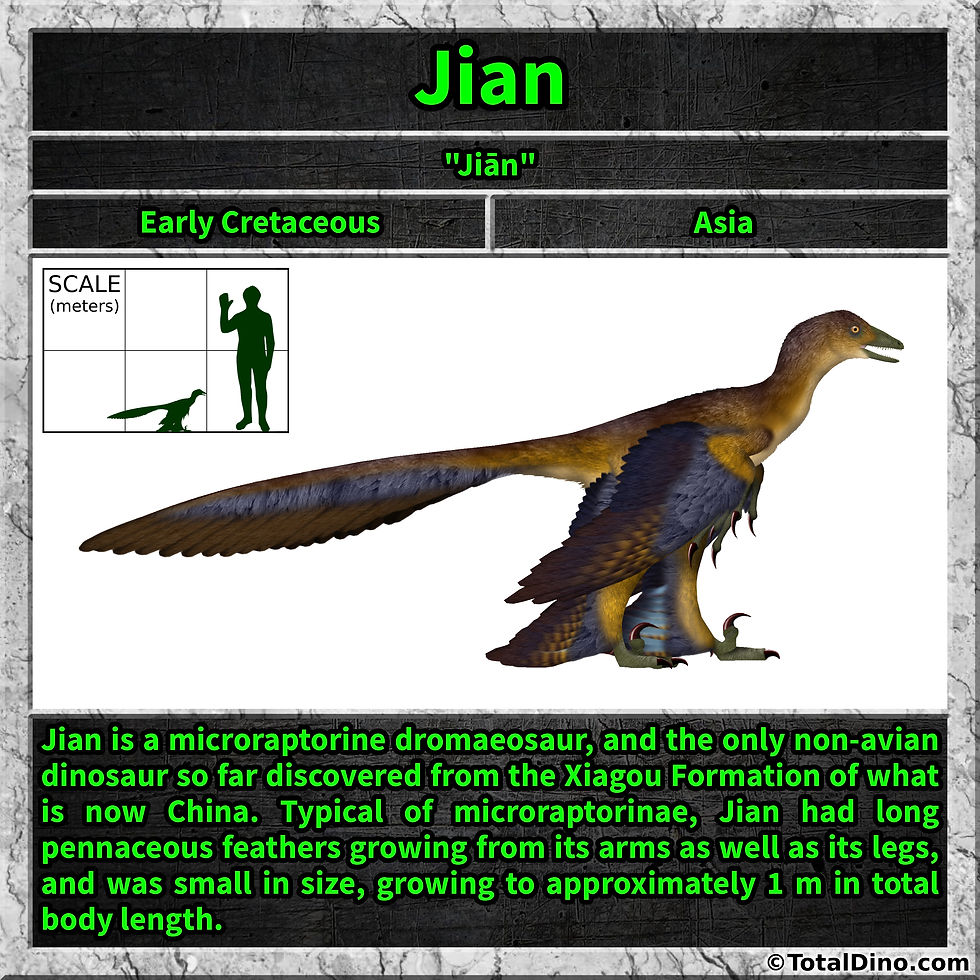
Jian is a microraptorine dromaeosaur, and the only non-avian dinosaur so far discovered from the Xiagou Formation of what is now China. Typical of microraptorinae, Jian had long pennaceous feathers growing from its arms as well as its legs, and was small in size, growing to approximately 1 m in total body length.
Abstract from paper: Lacustrine sediments of the Lower Cretaceous (lower Aptian) Xiagou Formation exposed near the village of Changma in the Changma Basin of northwestern Gansu Province, China have yielded more than 100 avian partial skeletons, many of which also preserve remnants of soft tissues such as feathers and skin. Collectively, these fossils characterize a rich avifauna dominated by the crownward ornithuromorph Gansus yumenensis Hou and Liu, 1984. Despite this wealth of Early Cretaceous bird material, no skeletal remains of other dinosaurs have been described from Changma to date. Here we report the first non-avian dinosaur body fossil from the Xiagou Formation of the Changma Basin. Consisting of an articulated left pectoral girdle and forelimb lacking the carpus and manus, the specimen pertains to a new dromaeosaurid theropod taxon, Jian changmaensis, gen. et sp. nov. Phylogenetic analysis recovers Jian within Microraptorinae, expanding the definitive fossil record of this clade to include northwestern China. The new Changma microraptorine constitutes an additional similarity between the theropod faunas of the Xiagou Formation of the Changma Basin and penecontemporaneous strata of the Jehol Group of northeastern China. In particular, the Changma theropod assemblage closely resembles that of the Sihedang locality of the Jehol Group in that both include representatives of Microraptorinae and are overwhelmingly dominated by single ornithuromorph taxa that phylogenetic analyses have repeatedly resolved as close relatives. This raises the possibility that the two sites were deposited under comparable paleoenvironmental settings that are otherwise poorly represented at known Jehol localities.


Jian is from the Early Cretaceous. The Cretaceous is the third and final geological period of the Mesozoic Era, with the Early Cretaceous making up roughly the first half, lasting from about 143 to 100 million years ago. The poles were ice-free, due to the relatively warm climate, and forests extended into high latitudes. The continued breakup of the continents created new coastlines and isolated landmasses, influencing the evolution of distinct dinosaur faunas.
It was a time of transition, as many groups of animals and plants began to take on more modern forms while others declined or disappeared. Pterosaurs continued to thrive, though early birds were becoming more diverse and widespread. Mammals remained small but adapted to a variety of ecological niches. In the oceans, ichthyosaurs and plesiosaurs were common, and early mosasaurs began to appear.
Dinosaurs remained the dominant land animals, with groups like iguanodontians, spinosaurids, and carcharodontosaurids rising to prominence. While sauropods declined in some regions, they remained abundant in the Southern Hemisphere. The first true ceratopsians appeared, and ankylosaurs replaced stegosaurs in their niche. Dromaeosaurs and other small theropods diversified. During this time, the first flowering plants evolved, gradually changing global ecosystems by providing new food sources for herbivores.

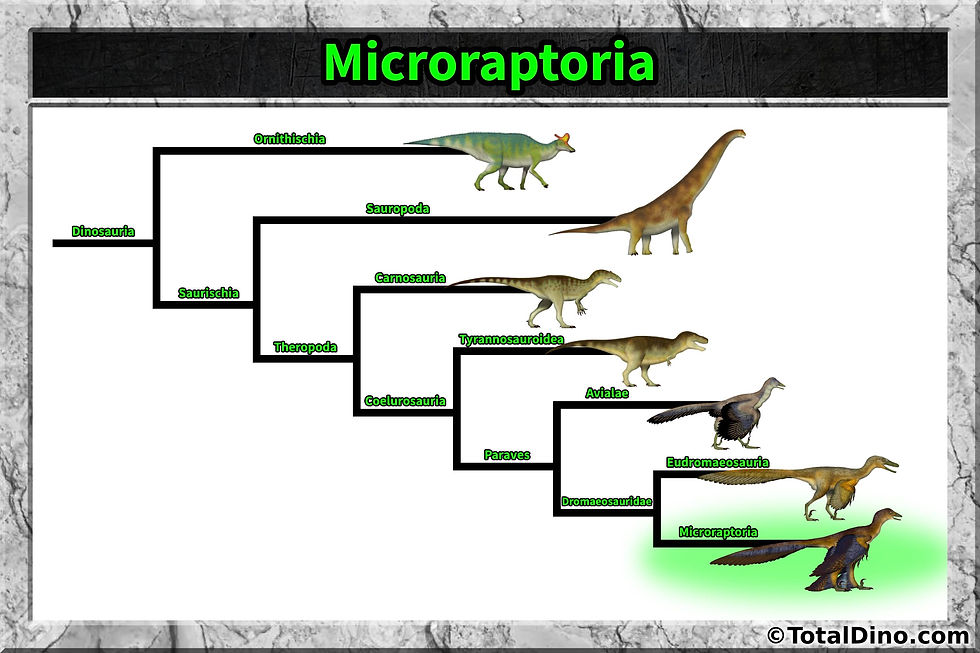
Jian is a microraptorian dromaeosaur. Microraptoria is a group of small, long-feathered dromaeosaurids known almost entirely from the Early Cretaceous of China. Most were crow- to turkey-sized, with slender bodies, long tails, and often well-preserved plumage. Their most distinctive trait is the presence of long, asymmetrical flight feathers on both the arms and the legs, forming a four-winged body plan unlike anything seen in modern birds. Some species also had elongated tail feathers, in some cases forming fan or diamond-shaped display structures.
Microraptorians are among the best evidence that gliding, and possibly limited powered flight, evolved among non-avian paravians. Fossils show stiff, aerodynamically shaped feathers, and biomechanical studies suggest that species like Microraptor could glide effectively between trees. Their diets appear to have been varied and opportunistic. Preserved stomach contents include fish, birds, mammals, and lizards, indicating they hunted in both arboreal and terrestrial settings. Some specimens also preserve iridescent feather structures, suggesting glossy black plumage in at least a few species.
Microraptorians sit near the base of Dromaeosauridae, and their small size and feather-covered limbs offer a valuable window into how flight-related traits arose in the lineage leading toward birds.


Comments