

Ardetosaurus
MEANING: Burn lizard
PERIOD: Late Jurassic
CONTINENT: North America
Sauropods are large quadrupedal herbivorous dinosaurs known for their long necks. Ardetosaurus is a diplodocid sauropod estimated to have grown to around 18 m in length. Typical of diplodocids, Ardetosaurus had an extremely long whip-like tail to balance its long neck. Diplodocids are also characterized by their thin pencil-like teeth.

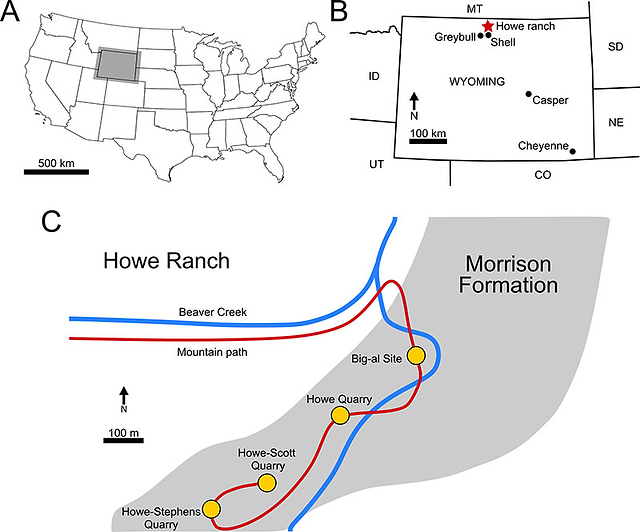
Abstract from paper: The Morrison Formation of the western United States is well-known for its high diversity of sauropod dinosaurs. The Howe-Stephens Quarry in northern Wyoming is one of several quarries which has yielded several associated to completely articulated dinosaur specimens, among which a semi-articulated diplodocid specimen, MAB011899, which was excavated in 1993. This diplodocid specimen is represented by posterior cervical, dorsal, sacral, and anterior caudal vertebrae, multiple thoracic ribs, two chevrons, a left coracoid, a left ilium, both pubes and ischia, a left femur, a left tibia, and a left fibula. Through comparative anatomy, we interpret this specimen as a new species of diplodocine sauropod, Ardetosaurus viator gen. et sp. nov. Unambiguous autapomorphies include paired accessory laminae in the spinoprezygapophyseal fossae of posterior cervical and anterior dorsal vertebrae, bifurcating anterior centrodiapophyseal laminae in the anterior dorsal vertebrae, fossae present in the centropostzygapophyseal laminae of the second dorsal vertebra, a low vertebral height/centrum length ratio of the posterior dorsal vertebrae and reduced to absent centroprezygapophyseal laminae in the anterior caudal vertebrae. Local autapomorphic features include single centroprezygapophyseal laminae in the posterior cervical vertebrae and a highly elliptical cross-section of the femoral midshaft. Ardetosaurus viator is the first skeletally mature sauropod specimen described from the Howe-Stephens Quarry. This specimen provides insight into serial variation of vertebral laminae and laminar transitions. Finally, the peculiar morphology of the—often not preserved—first chevron is described in detail, and its possible use in studying sexual dimorphism in sauropods is discussed.



Ardetosaurus is from the Late Jurassic. The Late Jurassic was a dynamic period, spanning from about 162 to 143 million years ago. The continents were continuing to drift apart, and the supercontinent Pangaea had fully split into Laurasia in the north and Gondwana in the south. This continental rearrangement led to the formation of large inland seas and shallow coastlines that fostered diverse ecosystems. The climate during the Late Jurassic was warm and humid, with lush forests of conifers and ferns that stretched across much of the continents, creating a rich ecosystem where dinosaurs flourished the dominant land animals.
Dinosaurs continued to diversify through the Late Jurassic, with some of the most famous species evolving in this time. Many well-known sauropods, such as Brachiosaurus and Apatosaurus roamed the land, exhibiting niche partitioning with their selectively distinct neck positions. Alongside them, stegosaurs became widespread, their plates and spikes making them one of the era's most recognizable groups. Theropods like Allosaurus and Ceratosaurus were the apex predators, evolving large, powerful bodies and sharp teeth that allowed them to hunt the gigantic herbivores. The early evolution of birds was taking place, setting the stage for the numerous species that would fill the skies in the eras to come.
Unlike the dramatic mass extinctions that marked the beginning and end of the Mesozoic, the Jurassic Period ended without a sharp boundary. As the continents continued to drift, ecosystems gradually transformed into unique habitats that supported the more specialized dinosaur species of the Cretaceous.

Ardetosaurus is a diplodocid. Diplodocidae is a family of long-necked sauropod dinosaurs that includes some of the longest animals to have ever walked the Earth. These herbivorous giants lived during the Late Jurassic Period and are known for their exceptionally elongated bodies, particularly their necks and tails. Diplodocids typically had relatively light, whip-like tails and long, slender necks with peg-like teeth concentrated at the front of the jaws - adaptations likely suited for stripping leaves from soft vegetation.
Unlike some other sauropod groups, diplodocids had relatively low-slung bodies and held their necks horizontally, possibly allowing them to feed efficiently on low-lying plants. Fossil evidence suggests they were abundant in what is now North America, South America, and parts of Africa and Europe, indicating a wide distribution. Their streamlined body plan and specialized feeding strategies made them one of the most successful sauropod lineages of the Jurassic, before eventually disappearing by the beginning of the Cretaceous.


Comments