

Brontotholus
Updated: Dec 23, 2025
MEANING: Thunder dome
PERIOD: Late Cretaceous
CONTINENT: North America
Brontotholus is a relatively large pachycephalosaurian dinosaur. Like all pachycephalosaurs, it was bipedal and sported the characteristic bony dome on top of its skull. Brontotholus grew to nearly 4 m in length, making it one of the largest known pachycephalosaurs, and the largest from the Campanian age.

Abstract from paper: During the latest Cretaceous, western North America experienced several regressive and transgressive cycles of the Western Interior Seaway (WIS). Closely related, time-successive taxa of tyrannosaurids, ceratopsids, hadrosaurids, and pachycephalosaurids have been proposed to have evolved via anagenesis driven by habitat area fluctuations related to sea level change. Previous examinations into these anagenetic hypotheses have resulted in equivocal results. However, evolution related to this WIS hypothesis has yet to be tested for Pachycephalosauria. Originally, it was hypothesized that an undescribed taxon from the Two Medicine Formation constituted an anagenetic intermediate between the Campanian Stegoceras validum and the Maastrichtian Pachycephalosaurus wyomingensis. Here we describe this Two Medicine Formation pachycephalosaurid and test the proposed anagenetic lineage. This taxon is the first pachycephalosaurid from the Two Medicine Formation, and the massive frontoparietal dome indicates that it was the third largest North American pachycephalosaurid. Phylogenetic analyses recover this new taxon distant from both Stegoceras and Pachycephalosaurus; thus, refuting the hypothesis that this taxon constitutes any part of an ancestor–descent series between Stegoceras and Pachycephalosaurus. However, the new taxon not only increases understanding of pachycephalosaurid morphology and diversity, but shows that this clade contained relatively large body-sized taxa as early as the Middle Campanian.


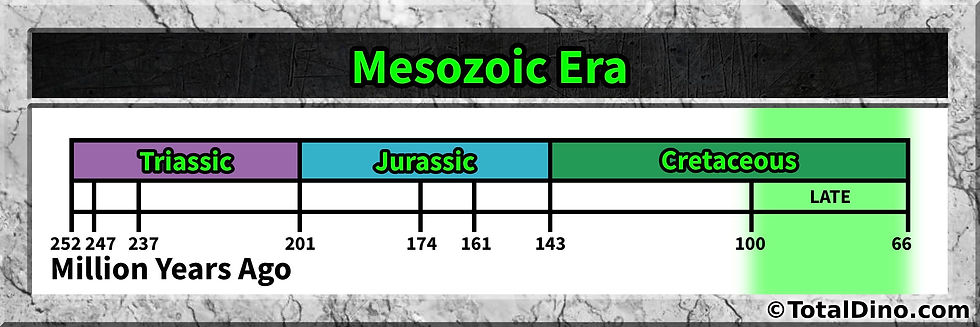
Brontotholus is from the Late Cretaceous. The Cretaceous is the third and final geological period of the Mesozoic Era, with the Late Cretaceous making up roughly the second half of it, lasting from about 100 to 66 million years ago. It was a time of significant evolutionary change, with dinosaurs reaching their greatest diversity before the mass extinction at the end of the Cretaceous.
The Cretaceous was a period with a relatively warm climate, though the Late Cretaceous experienced a global cooling trend, caused by falling levels of carbon dioxide in the atmosphere. The continents were nearing their present positions, but high sea levels flooded low-lying regions, turning Europe into an archipelago, and forming the Western Interior Seaway in North America. These seas were home to a variety of marine reptiles, including mosasaurs and plesiosaurs, while pterosaurs and birds shared the skies.
On land, dinosaurs continued to thrive and diversify during the Late Cretaceous, producing many of the most well-known groups, including tyrannosaurs, hadrosaurs, and pachycephalosaurs. Established Cretaceous dinosaur clades like the ceratopsians, ankylosaurs, and dromaeosaurs continued to flourish. Sauropod species consisted almost exclusively of titanosaurs, which seemed to be confined to the Southern Hemisphere for much of the Late Cretaceous. Flowering plants and grasses diversified and spread, becoming the dominant flora similar to what we see today.
The Cretaceous (along with the Mesozoic) ended with the Cretaceous-Paleogene (K-Pg) extinction event, a large mass extinction in which many groups, including non-avian dinosaurs, pterosaurs, and large marine reptiles, died out. This event, likely triggered by an asteroid impact, is marked by the abrupt K-Pg boundary, a distinct geologic layer separating the Mesozoic and Cenozoic Eras. In its aftermath, mammals and avian dinosaurs rapidly diversified, becoming the dominant land animals of the Cenozoic Era.
Brontotholus is a pachycephalosaur. Pachycephalosauria, meaning "thick headed lizards" is a group of ornithischian dinosaurs ornithischian dinosaurs known for their thickened skull roofs. Along with ceratopsians, they belong to the clade Marginocephalia, a lineage characterized by unique features at the back of the skull. Pachycephalosaurs were herbivorous, bipedal dinosaurs that thrived almost exclusively in the Late Cretaceous, and are only known from the Northern Hemisphere. Their fossil record is relatively sparse, but distinct enough to paint a picture of an unusual group with heavily reinforced skulls.
These thick-skulled dinosaurs came in a variety of forms, with skulls that could be domed, flat, or even wedge-shaped depending on the species. In some, the domes were surrounded by small spikes and bony nodes. The function of these thickened skulls has been debated, but one of the leading theories suggests they were used for head-butting or flank-butting during social displays or dominance contests, similar to behavior seen in modern-day goats. While this behavior is still debated, the biomechanics of their skulls suggest they were capable of absorbing substantial force, making the theory of intra-species combat a strong possibility.


Comments