

Ceratocaudia
Updated: Jul 21
MEANING: Horned tail
PERIOD: Middle Jurassic
CONTINENT: Asia
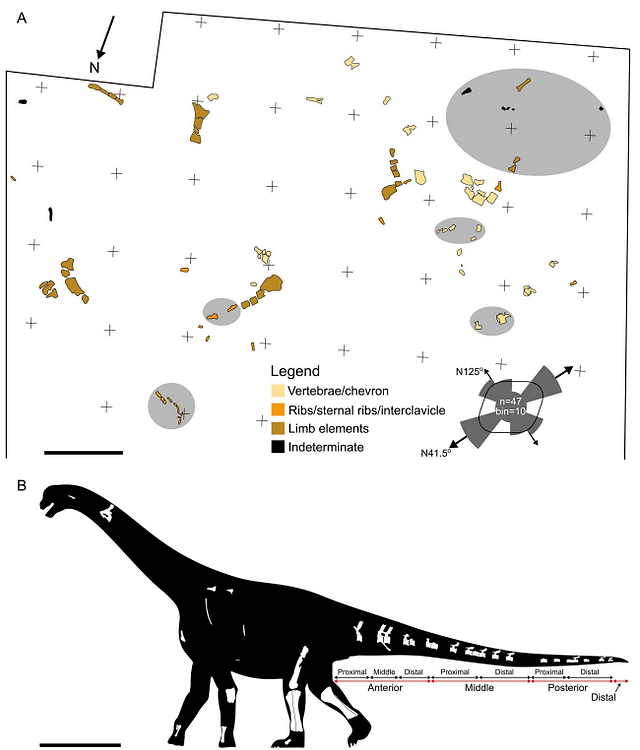
Ceratocaudia is a basal macronarian sauropod dinosaur that lived during the Jurassic Period in what is now India. It may be the earliest macronarian known in the fossil record. Estimated at about 7 m in length, Ceratocaudia is one of the smallest known macronarians. There is a possibility that it represents a dwarf taxon.

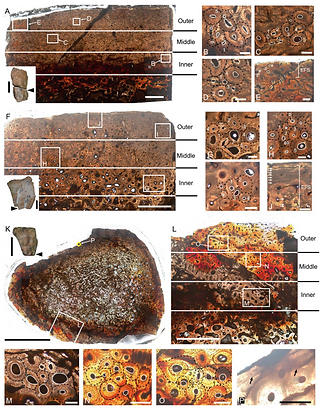
Abstract from paper: In this study, we report a partial skeleton of a small (ca. 7 m) sauropod dinosaur from the ?upper Lower Jurassic (Pliensbachian) to Bajocian strata of the Kaladongar Formation (Khadir Uplift), Kachchh Basin, India. The partial skeleton is described and established as the holotype of a new taxon, Ceratocaudia antiqua gen. et sp. nov., diagnosed by a notch on the cervical postzygapophysis, a horn-like crest on the anterior caudal neural spine, progressive shift from platycoelous to procoelous articular facets in the posterior caudal vertebrae, anterior chevron with split articular facets (local autapomorphy), a deeply concave (notched) anterior surface of the distal tibia, and a well-developed anteromedial crest and subtriangular distal epiphyses in the fibula (local autapomorphies). Additional fragmentary remains from the same strata at a nearby locality are referred to the new taxon. Phylogenetic analyses best support the recovery of the new taxon as an early-branching, non-titanosauriform macronarian. The long bone histology and non-traumatic, non-contagious pathology indicate senescence in the holotype. The possibility of dwarfism in C. antiqua, based on size and ontogenetic stage of the holotype, is discussed. A hypothetical caudal musculoskeletal reconstruction of C. antiqua, generated using retrodeformed and reconstructed elements of the holotype, is used to determine tentative functional morphological implications, including the use of the tail as a mild deterrent to predators. Time-calibrated phylogeny of macronarian taxa suggests a pre-Bajocian global distribution, supporting recent hypotheses on neosauropod paleobiogeography. Ceratocaudia antiqua is the earliest diagnosable macronarian neosauropod from India and represents one of its earliest global occurrences.




Ceratocaudia is from the Middle Jurassic. The Middle Jurassic, spanning from approximately 174 to 163 million years ago, was a period of increasing tectonic activity and evolutionary innovation. By this time, the supercontinent Pangaea had begun to split more significantly, with Laurasia in the north and Gondwana in the south drifting apart. This movement created new coastlines, shallow seas, and rift valleys that fostered diverse ecosystems. The climate remained generally warm and humid, promoting the spread of lush vegetation, including ferns, cycads, and conifers, which blanketed much of the land and supported a wide variety of herbivorous dinosaurs.
Though less well known than the Late Jurassic, the Middle Jurassic was an important evolutionary chapter. Several major dinosaur groups began to diversify, including the stegosaurs and more derived long-necked sauropods that would later dominate the landscape. Theropods also continued to evolve, giving rise to new lineages like the megalosaurids and the early ancestors of more derived carnivores. Fossil evidence from this interval is relatively scarce compared to later stages, but what we do have paints a picture of an increasingly complex world, setting the stage for the iconic ecosystems of the Late Jurassic.

Ceratocaudia is a macronarian. Macronaria is a major clade of sauropod dinosaurs, characterized by their large nasal openings. This group includes some of the most famous and massive dinosaurs in history, such as Brachiosaurus and Camarasaurus, as well as their many relatives that flourished from the Jurassic through the Cretaceous Periods. Macronarians were herbivorous, long-necked dinosaurs with relatively upright neck posture, allowing them to feed from tall trees and vegetation other sauropods may not have reached. Their skulls tend to be short and boxy compared to the more elongated skulls of diplodocoids, and their teeth were often spoon-shaped, well-suited for stripping leaves rather than raking or cropping.
Early macronarians appeared in the Late Jurassic and were among the most common sauropods in their ecosystems. Later forms diversified dramatically, including the enormous titanosaurs that would dominate sauropod diversity in the Cretaceous. While the more basal members retained relatively conservative body plans, some later macronarians reached extreme sizes and adapted to a wide range of habitats. The group’s evolutionary success is reflected in its global distribution, with fossils found on every continent, including Antarctica. As some of the tallest terrestrial animals known from the fossil record, macronarians represent an important stage in the evolution of sauropod body plans and feeding strategies.


Comments