

Cryptarcus
Updated: Mar 30
MEANING: Hidden arch
PERIOD: Late Cretaceous
CONTINENT: North America
Cryptarcus is a ceratopsid dinosaur that was originally classified as a species of Chasmosaurus. More recent analysis of the fossil material recovered Cryptarcus as a distinct genus. Like all ceratopsids, Cryptarcus had a large frill protruding from the back of its skull, and a beak and batteries of teeth for processing its herbivorous diet.

Abstract from paper: Although the holotype of Chasmosaurus russelli Sternberg, 1940, from the upper Dinosaur Park Formation of southern Alberta, shares features with other Chasmosaurus Lambe, 1914 specimens from Dinosaur Provincial Park as well as various chasmosaurine taxa from the southwest United States, it also possesses unique features of the premaxilla and frill epiossifications. An iterative phylogenetic analysis, scoring only the holotype (CMNFV 8800), produces three consensus topologies, one of which places CMNFV 8800 closer to Chasmosaurus than to Pentaceratops, another in which CMNFV 8800 is closer to Pentaceratops than to Chasmosaurus, and a final topology in which these relationships are unresolved. Under current definitions, CMNFV 8800 cannot be accommodated within Chasmosaurus or any other known chasmosaurine genus. Consequently, we erect Cryptarcus gen. nov. to receive it. Cryptarcus russelli comb. nov. may represent a migrant originating from the southern “Pentaceratops clade”, but it may also be part of a lineage more closely related to Chasmosaurus in which Pentaceratops-like features (e.g., frill wider anteriorly than posteriorly, deep parietal embayment, and first epiparietals nearly touch at the midline) evolved convergently. None of our phylogenetic topologies support an anagenetic trend from Cryptarcus russelli through Pentaceratops to produce Terminocavus Fowler and Freedman Fowler, 2020, as has been recently hypothesized.


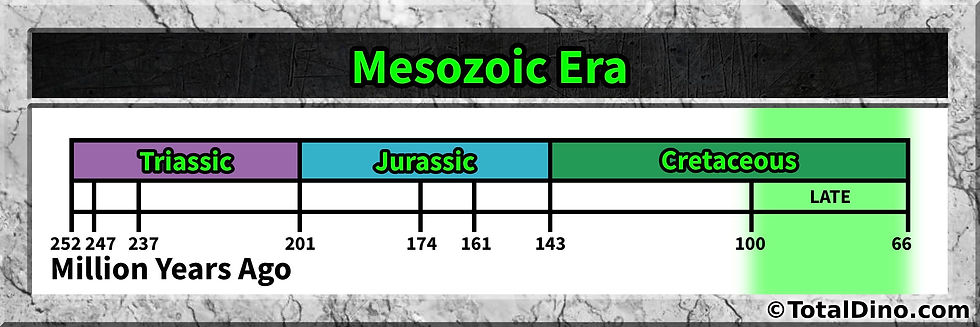
Cryptarcus is from the Late Cretaceous. The Cretaceous is the third and final geological period of the Mesozoic Era, with the Late Cretaceous making up roughly the second half of it, lasting from about 100 to 66 million years ago. It was a time of significant evolutionary change, with dinosaurs reaching their greatest diversity before the mass extinction at the end of the Cretaceous.
The Cretaceous was a period with a relatively warm climate, though the Late Cretaceous experienced a global cooling trend, caused by falling levels of carbon dioxide in the atmosphere. The continents were nearing their present positions, but high sea levels flooded low-lying regions, turning Europe into an archipelago, and forming the Western Interior Seaway in North America. These seas were home to a variety of marine reptiles, including mosasaurs and plesiosaurs, while pterosaurs and birds shared the skies.
On land, dinosaurs continued to thrive and diversify during the Late Cretaceous, producing many of the most well-known groups, including tyrannosaurs, hadrosaurs, and pachycephalosaurs. Established Cretaceous dinosaur clades like the ceratopsians, ankylosaurs, and dromaeosaurs continued to flourish. Sauropod species consisted almost exclusively of titanosaurs, which seemed to be confined to the Southern Hemisphere for much of the Late Cretaceous. Flowering plants and grasses diversified and spread, becoming the dominant flora similar to what we see today.
The Cretaceous (along with the Mesozoic) ended with the Cretaceous-Paleogene (K-Pg) extinction event, a large mass extinction in which many groups, including non-avian dinosaurs, pterosaurs, and large marine reptiles, died out. This event, likely triggered by an asteroid impact, is marked by the abrupt K-Pg boundary, a distinct geologic layer separating the Mesozoic and Cenozoic Eras. In its aftermath, mammals and avian dinosaurs rapidly diversified, becoming the dominant land animals of the Cenozoic Era.
Cryptarcus is a chasmosaurine ceratopsid. Ceratopsians were a group of herbivorous ornithischian dinosaurs characterized by their beaked faces, elaborate skull ornamentation, and often dramatic frills and horns. Originating in the Jurassic as small bipedal animals, ceratopsians gradually evolved into larger and more quadrupedal forms over time. By the Late Cretaceous, they had become one of the dominant herbivorous groups in North America and parts of Asia. Their tooth batteries were well-suited for slicing through tough vegetation, and their facial horns and frills are thought to have been used in species recognition, display, and possibly defense or intraspecific combat.
Chasmosaurinae was one of the two major branches of advanced ceratopsids. They typically had long brow horns above the eyes, shorter nose horns, and expansive frills. These dinosaurs were primarily found in western North America. Their size, complex skull ornamentation, and highly specialized teeth made them some of the most iconic Late Cretaceous herbivores. The evolution of increasingly elaborate frills and horns among chasmosaurines suggests strong selective pressures, perhaps from mating rituals or social behavior, as well as regional differences across their range.
Chasmosaurinae and the generally smaller-bodied centrosaurinae together make up the ceratopsidae, the most derived group within the ceratopsia.


Awesome! My favorite among 2026's dinosaurs!