

Dasosaurus
MEANING: Forest lizard
PERIOD: Early Cretaceous
CONTINENT: South America
Dasosaurus is a macronarian sauropod dinosaur whose discovery has helped clarify sauropod dispersal in the Cretaceous. Not a true titanosaur, its discovery in what is now Brazil places it in a pivotal evolutionary and geographic position, bridging earlier sauropods of the northern continents with the true giants known from South America.

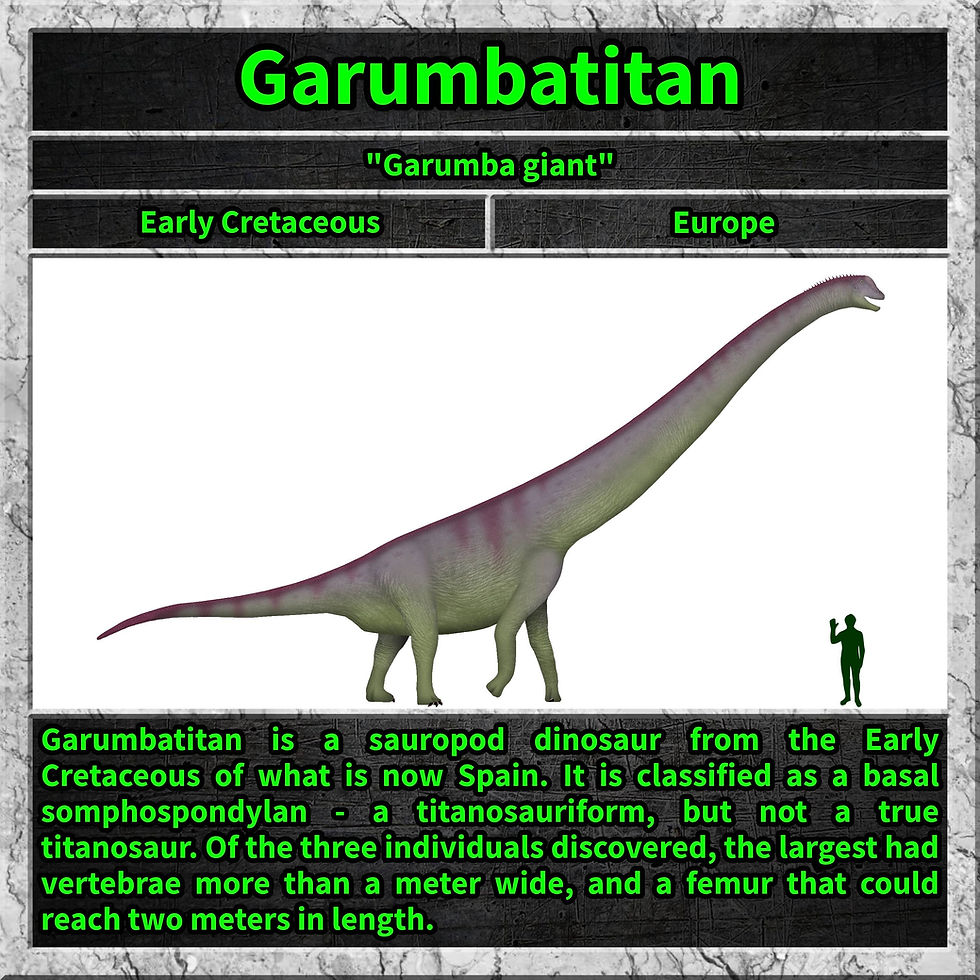
Abstract from paper: A non-titanosaur Somphospondyli specimen unearthed from Early Cretaceous (Aptian) deposits of north-eastern Brazil allowed the establishment of a new taxon, Dasosaurus tocantinensis gen. et sp. nov. Shared synapomorphic traits, notably a complex of three anteroposteriorly elongated ridges in the middle and posterior caudal vertebrae, with a groove above the ventral one, and a well-developed lateral bulge on the femur, support the position of the new sauropod as sister to Garumbatitan morellensis, from the Barremian of Spain. Osteohistological patterns recognized in D. tocantinensis include a mixture of traits previously recognized separately in early diverging neosauropods and later titanosaurs, including an external fundamental system and remains of primary laminar tissue, along with a high degree of secondary remodelling. Apart from expanding the known diversity of Early Cretaceous sauropods in the northern part of South America, this discovery highlights biogeographical connections with more northern Gondwanan areas, as well as Europe. In fact, numerical biogeographical analyses suggest that the clade formed by D. tocantinensis and Ga. morellensis had a European origin, with the lineage including D. tocantinensis dispersing to South America via northern Africa at some point between the Valanginian and Aptian.


Dasosaurus is from the Early Cretaceous. The Cretaceous is the third and final geological period of the Mesozoic Era, with the Early Cretaceous making up roughly the first half, lasting from about 143 to 100 million years ago. The poles were ice-free, due to the relatively warm climate, and forests extended into high latitudes. The continued breakup of the continents created new coastlines and isolated landmasses, influencing the evolution of distinct dinosaur faunas.
It was a time of transition, as many groups of animals and plants began to take on more modern forms while others declined or disappeared. Pterosaurs continued to thrive, though early birds were becoming more diverse and widespread. Mammals remained small but adapted to a variety of ecological niches. In the oceans, ichthyosaurs and plesiosaurs were common, and early mosasaurs began to appear.
Dinosaurs remained the dominant land animals, with groups like iguanodontians, spinosaurids, and carcharodontosaurids rising to prominence. While sauropods declined in some regions, they remained abundant in the Southern Hemisphere. The first true ceratopsians appeared, and ankylosaurs replaced stegosaurs in their niche. Dromaeosaurs and other small theropods diversified. During this time, the first flowering plants evolved, gradually changing global ecosystems by providing new food sources for herbivores.

Dasosaurus is a macronarian. Macronaria is a major clade of sauropod dinosaurs, characterized by their large nasal openings. This group includes some of the most famous and massive dinosaurs in history, such as Brachiosaurus and Camarasaurus, as well as their many relatives that flourished from the Jurassic through the Cretaceous Periods. Macronarians were herbivorous, long-necked dinosaurs with relatively upright neck posture, allowing them to feed from tall trees and vegetation other sauropods may not have reached. Their skulls tend to be short and boxy compared to the more elongated skulls of diplodocoids, and their teeth were often spoon-shaped, well-suited for stripping leaves rather than raking or cropping.
Early macronarians appeared in the Late Jurassic and were among the most common sauropods in their ecosystems. Later forms diversified dramatically, including the enormous titanosaurs that would dominate sauropod diversity in the Cretaceous. While the more basal members retained relatively conservative body plans, some later macronarians reached extreme sizes and adapted to a wide range of habitats. The group’s evolutionary success is reflected in its global distribution, with fossils found on every continent, including Antarctica. As some of the tallest terrestrial animals known from the fossil record, macronarians represent an important stage in the evolution of sauropod body plans and feeding strategies.



Comments