

Eopinacosaurus
Updated: May 19
MEANING: Dawn Pinacosaurus
PERIOD: Late Cretaceous
CONTINENT: Asia
Eopinacosaurus is an ankylosaurid dinosaur that was originally assigned to Pinacosaurus, until a 2026 analysis reassigned it as a distinct genus. Like all ankylosaurs, it was a heavily armored quadrupedal herbivore. Notable defensive adaptations include the characteristic tail club, as well as sizable horns protruding backward from the head.

Abstract from paper: The recovery in recent years of dozens of new specimens of the armoured dinosaur Pinacosaurus allows a re-evaluation of this important Late Cretaceous taxon. The holotype of Pinacosaurus grangeri consists of a badly crushed skull, mandibles, and fragmentary cervical material. Here it is redescribed in light of what is presently known about ankylosaurids. Pinacosaurus sensu stricto is characterised by several unusual features including a supranarial embayment, a nasoprefrontal pyramid, multiple paranasal apertures, and a lack of osteoderms or caputegulae in the frontoparietal region. The occipital condyle is reniform as in most or all other ankylosaurids, with fusion of the exoccipital condyloids occurring ontogenetically. Other specimens from the same locality as the holotype, Bayn Dzak, also represent P. grangeri. Site-specific and/or horizon-specific morphs characterise Bayn Dzak, Ukhaa Tolgod, Alag Teeg, and other localities, suggesting multiple species of Pinacosaurus. A limited specimen-level cladistic analysis confirms that: (1) some Pinacosaurus sensu stricto specimens are distinct from P. grangeri and represent a second species, P. hilwitnorum, sp. nov.; (2) ‘Pinacosaurus’ mephistocephalus is not referable to Pinacosaurus and therefore requires a new generic name, Eopinacosaurus, gen. nov.; and (3) Minotaurasaurus is probably distinct from Pinacosaurus (and is not Tarchia). The diversity and distribution of Pinacosaurus is a key to understanding the spatiotemporal relationships among Late Cretaceous Gobi Basin localities.


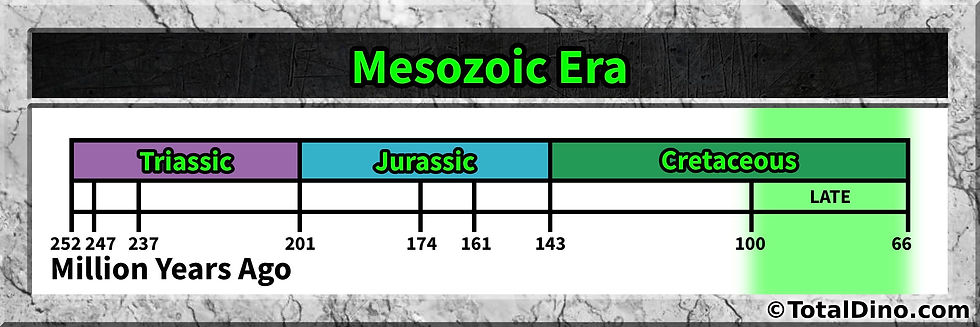
Eopinacosaurus is from the Late Cretaceous. The Cretaceous is the third and final geological period of the Mesozoic Era, with the Late Cretaceous making up roughly the second half of it, lasting from about 100 to 66 million years ago. It was a time of significant evolutionary change, with dinosaurs reaching their greatest diversity before the mass extinction at the end of the Cretaceous.
The Cretaceous was a period with a relatively warm climate, though the Late Cretaceous experienced a global cooling trend, caused by falling levels of carbon dioxide in the atmosphere. The continents were nearing their present positions, but high sea levels flooded low-lying regions, turning Europe into an archipelago, and forming the Western Interior Seaway in North America. These seas were home to a variety of marine reptiles, including mosasaurs and plesiosaurs, while pterosaurs and birds shared the skies.
On land, dinosaurs continued to thrive and diversify during the Late Cretaceous, producing many of the most well-known goups, including tyrannosaurs, hadrosaurs, and pachycephalosaurs. Established Cretaceous dinosaur clades like the ceratopsians, ankylosaurs, and dromaeosaurs continued to flourish. Sauropod species consisted almost exclusively of titanosaurs, which seemed to be confined to the Southern Hemisphere for much of the Late Cretaceous. Flowering plants and grasses diversified and spread, becoming the dominant flora similar to what we see today.
The Cretaceous (along with the Mesozoic) ended with the Cretaceous-Paleogene (K-Pg) extinction event, a large mass extinction in which many groups, including non-avian dinosaurs, pterosaurs, and large marine reptiles, died out. This event, likely triggered by an asteroid impact, is marked by the abrupt K-Pg boundary, a distinct geologic layer separating the Mesozoic and Cenozoic Eras. In its aftermath, mammals and avian dinosaurs rapidly diversified, becoming the dominant land animals of the Cenozoic Era.
Eopinacosaurus is an ankylosaurid. Ankylosaurids are a family of armored dinosaurs within Ankylosauria, best known for the large bony clubs at the ends of their tails, distinguishing them from their nodosaurid relatives. Like all ankylosaurs, they were herbivorous, quadrupedal, and covered in bony osteoderms for defense. Ankylosaurids typically had broader, more triangular skulls, shorter limbs, and a more compact body compared to nodosaurids.
They first appeared in the Early Cretaceous and persisted until the end of the Mesozoic. Fossils of ankylosaurids are most commonly found in North America and Asia. Ankylosauridae and nodosauridae make up the larger group ankylosauria, which, along with the stegosaurs, form the group Thyreophora, known for their various combinations of armor and spikes.


Comments