

Ferenceratops
Updated: Jan 8
MEANING: Ferenc horned face
PERIOD: Late Cretaceous
CONTINENT: Europs
Ferenceratops was initially classified under the ornithopod genus Zalmoxes, until it was found that it more closely resembled an early ceratopsian. Ferenceratops was a small quadrupedal herbivore, growing to 1.5-2 m in body length, likely using the characteristic ceratopsian beak to process vegetation.

Abstract from paper: Late Cretaceous Europe was an archipelago with a dinosaur fauna characterized by island effects such as low diversity, relictualism and insular dwarfism1. Its dinosaur communities include a unique mix of groups with typical Laurasian or Gondwanan affinities and distinctive endemics1. Chief among the latter are rhabdodontids, considered to be early-branching iguanodontians characterized by unusual dental and postcranial features and known from abundant but very incomplete fossil remains2,3. By contrast, unequivocal evidence of horned dinosaurs (ceratopsians) is puzzlingly absent4, despite their ubiquitous occurrence in contemporary ecosystems of Asia and North America. Ajkaceratops from the Late Cretaceous of Hungary was described as the first definite ceratopsian from Europe5, but this identification has been strongly disputed4. Here we describe new material of Ajkaceratops and conduct phylogenetic analyses that support its ceratopsian affinities. Our results unexpectedly demonstrate that some ‘rhabdodontid’ taxa are not, in fact, iguanodontians but actually ceratopsians. This suggests a substantial but previously hidden diversity and evolutionary history of European horned dinosaurs, and co-occurrence of iguanodontians and ceratopsians indicates greater similarity than previously appreciated to other Laurasian ecosystems. Our results challenge conventional understanding of ornithischian dinosaur evolution and indicate the need for a fundamental re-evaluation of the Late Cretaceous herbivorous dinosaur assemblages of Europe.


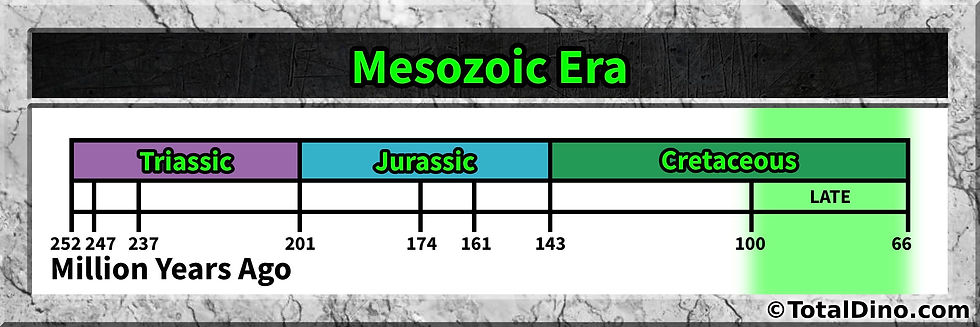
Ferenceratops is from the Late Cretaceous. The Cretaceous is the third and final geological period of the Mesozoic Era, with the Late Cretaceous making up roughly the second half of it, lasting from about 100 to 66 million years ago. It was a time of significant evolutionary change, with dinosaurs reaching their greatest diversity before the mass extinction at the end of the Cretaceous.
The Cretaceous was a period with a relatively warm climate, though the Late Cretaceous experienced a global cooling trend, caused by falling levels of carbon dioxide in the atmosphere. The continents were nearing their present positions, but high sea levels flooded low-lying regions, turning Europe into an archipelago, and forming the Western Interior Seaway in North America. These seas were home to a variety of marine reptiles, including mosasaurs and plesiosaurs, while pterosaurs and birds shared the skies.
On land, dinosaurs continued to thrive and diversify during the Late Cretaceous, producing many of the most well-known goups, including tyrannosaurs, hadrosaurs, and pachycephalosaurs. Established Cretaceous dinosaur clades like the ceratopsians, ankylosaurs, and dromaeosaurs continued to flourish. Sauropod species consisted almost exclusively of titanosaurs, which seemed to be confined to the Southern Hemisphere for much of the Late Cretaceous. Flowering plants and grasses diversified and spread, becoming the dominant flora similar to what we see today.
The Cretaceous (along with the Mesozoic) ended with the Cretaceous-Paleogene (K-Pg) extinction event, a large mass extinction in which many groups, including non-avian dinosaurs, pterosaurs, and large marine reptiles, died out. This event, likely triggered by an asteroid impact, is marked by the abrupt K-Pg boundary, a distinct geologic layer separating the Mesozoic and Cenozoic Eras. In its aftermath, mammals and avian dinosaurs rapidly diversified, becoming the dominant land animals of the Cenozoic Era.
Ferenceratops is a basal ceratopsian. Ceratopsia is a group of herbivorous ornithischian dinosaurs best known for their beaked mouths and elaborate frills. While the large North American ceratopsids of the Late Cretaceous are well-known for their massive skulls and prominent horns, basal ceratopsians were much more modest animals. They were typically small, lightly built, and either bipedal or capable of walking on all fours. They lacked the dramatic horns and oversized frills of their later relatives, but still carried the key features of the group, including the distinctive parrot-like beak adapted for cropping tough plant material.
Basal ceratopsians were particularly common in Asia, where their fossils have been found across a wide range of environments, from arid deserts to lush river valleys, indicating that these small dinosaurs were ecologically versatile and evolutionarily successful. Fossil discoveries help paleontologists trace the gradual development of traits that would later culminate in the massive, ornamented skulls of ceratopsids. These unassuming early members of the ceratopsian lineage played a foundational role in the evolution of one of the most iconic dinosaur groups of the Mesozoic.


Comments