

Foskeia
MEANING: Light forager
PERIOD: Early Cretaceous
CONTINENT: Europe
Foskeia is a small bodied lightly-built rhabdodontomorph ornithopod dinosaur. It lived during the Early Cretaceous period in what is now Spain.
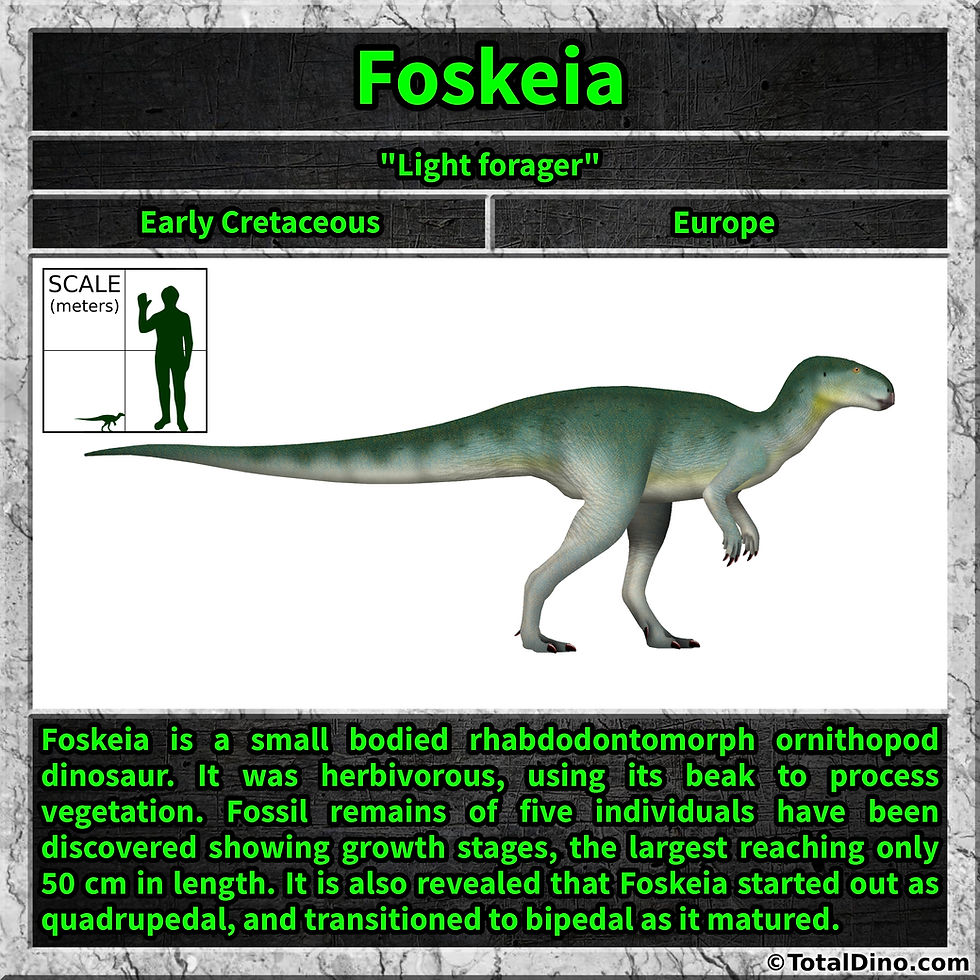
Abstract from paper: The Vegagete ornithopod is a diminutive bipedal iguanodont from the upper Barremian to lower Aptian (Lower Cretaceous) Castrillo de la Reina Formation of the Burgos Province (Spain). This dinosaur is principally known from disarticulated and fragmentary postcranial remains and was established as the earliest rhabdodontomorph. However, the nature of this material did not allow formal diagnosis of what still appeared to be a new taxon due to its particularly small body size. Recently, new cranial elements have been identified. These elements underwent micro-computed tomography scanning, segmentation and three-dimensional assembly. We herein name the Vegagete ornithopod Foskeia pelendonum gen. et sp. nov. It is diagnosed by a high number of unique features such as the possession of fused premaxillae, procumbent premaxillary teeth, one filiform first dentary tooth, and an elevated craniomandibular joint. Simultaneously, we observe a unique ventrolateral extension of the insertion of the muscle adductor mandibulae externus superficialis on the coronoid process of the dentary. Answering a number of phylogenetic controversies, we provide an updated, taxonomically augmented ornithischian phylogeny toward poorly sampled regions of the ornithischian tree. Rhabdodontia nov. is defined as a restricted clade of European rhabdodontomorphs, including F. pelendonum and rhabdodontids. Rhabdodontomorpha is nested to the base of Ankylopollexia. Thescelosauridae includes Tenontosaurus, and Dryosauridae includes Elasmaria. Agilisaurus louderbacki and Minimocursor phunoiensis are basal ornithopods. Heterodontosauridae remains at the base of Pachycephalosauria. Silesauridae and Sauropodomorpha are resolved in a position closer to Ornithischia than to Theropoda. This provisional result is pending the inclusion of more saurischian characters and taxa.


Foskeia is from the Early Cretaceous. The Cretaceous is the third and final geological period of the Mesozoic Era, with the Early Cretaceous making up roughly the first half, lasting from about 143 to 100 million years ago. The poles were ice-free, due to the relatively warm climate, and forests extended into high latitudes. The continued breakup of the continents created new coastlines and isolated landmasses, influencing the evolution of distinct dinosaur faunas.
It was a time of transition, as many groups of animals and plants began to take on more modern forms while others declined or disappeared. Pterosaurs continued to thrive, though early birds were becoming more diverse and widespread. Mammals remained small but adapted to a variety of ecological niches. In the oceans, ichthyosaurs and plesiosaurs were common, and early mosasaurs began to appear.
Dinosaurs remained the dominant land animals, with groups like iguanodontians, spinosaurids, and carcharodontosaurids rising to prominence. While sauropods declined in some regions, they remained abundant in the Southern Hemisphere. The first true ceratopsians appeared, and ankylosaurs replaced stegosaurs in their niche. Dromaeosaurs and other small theropods diversified. During this time, the first flowering plants evolved, gradually changing global ecosystems by providing new food sources for herbivores.

Foskeia is a rhabdodontomorph. Rhabdodontomorpha was a group of basal ornithopods that lived primarily during the Late Cretaceous, representing an early offshoot of the ornithopod lineage that would eventually give rise to the hadrosaurs. These dinosaurs were generally medium-sized, herbivorous, and adapted for bipedal locomotion, with powerful hind limbs and relatively short forelimbs. While not as specialized as their hadrosaurid cousins, rhabdodontomorphs retained more primitive characteristics, such as deep skulls and robust jaws suited for a strong bite force. Their teeth were arranged in tight rows and adapted for shearing plant material, suggesting a diet of tough, fibrous vegetation.
Fossils of rhabdodontomorphs have been found primarily in Europe, where they may have been part of isolated dinosaur faunas on European island landmasses during the Late Cretaceous. While other ornithopods spread across much of the globe, rhabdodontomorphs appear to have remained restricted to Europe and parts of Gondwana. Their survival in these regions, perhaps due to geographic isolation or reduced competition, makes them a fascinating example of how more basal dinosaur groups could persist and thrive in niche environments even as more derived forms evolved elsewhere.


Comments