

Gongshuilong
Updated: Apr 2
MEANING: Gong River dragon
PERIOD: Late Cretaceous
CONTINENT: Asia
Gongshuilong is a medium-sized saurolophine hadrosaur reaching approximately 7 m in total body length. It is characterized by the distinct sail-like structure down the length of its tail. Like all hadrosaurs, Gongshuilong had a beak at the front of its snout, and batteries of teeth for processing its herbivorous diet.

Abstract from paper: A new saurolophine hadrosaurid, Gongshuilong fanwei, is named and described here based on a series of largely disarticulated bone elements from the middle of the Upper Cretaceous Lianhe Formation in Ganzhou City, Jiangxi Province, South China. This taxon is diagnosed by a unique combination of traits, including an elevated anterodorsal process of the maxilla which is slightly longer than the anteroventral one, dentary tooth crowns ornamented with a median primary ridge and relatively small marginal denticles, an extremely truncated edentulous region of the dentary, an anteroposteriorly wide ventral process of the postorbital, a poorly developed deltoid ridge on the lateral surface of the scapula, and markedly elongate, posterodorsally directed neural spines of the posterior caudal vertebrae that are moderately recurved. Phylogenetic analysis yielded a polytomy at the base of Brachylophosaurini within Saurolophinae, which is formed by Wulagasaurus, Gongshuilong, Acristavus and the clade of Maiasaura + (Probrachylophosaurus + Brachylophosaurus). Gongshuilong is the first reported hadrosaurid genus from South China and is the second taxon of Brachylophosaurini found in Asia. Its discovery increases the possibility of the Asian origin for Saurolophinae and Brachylophosaurini, based on biogeographical analysis for ancestral areas using the Bayesian binary method.

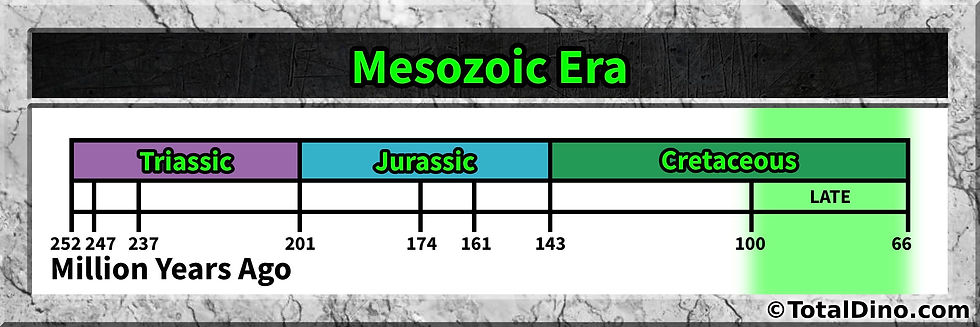
Gongshuilong is from the Late Cretaceous. The Cretaceous is the third and final geological period of the Mesozoic Era, with the Late Cretaceous making up roughly the second half of it, lasting from about 100 to 66 million years ago. It was a time of significant evolutionary change, with dinosaurs reaching their greatest diversity before the mass extinction at the end of the Cretaceous.
The Cretaceous was a period with a relatively warm climate, though the Late Cretaceous experienced a global cooling trend, caused by falling levels of carbon dioxide in the atmosphere. The continents were nearing their present positions, but high sea levels flooded low-lying regions, turning Europe into an archipelago, and forming the Western Interior Seaway in North America. These seas were home to a variety of marine reptiles, including mosasaurs and plesiosaurs, while pterosaurs and birds shared the skies.
On land, dinosaurs continued to thrive and diversify during the Late Cretaceous, producing many of the most well-known goups, including tyrannosaurs, hadrosaurs, and pachycephalosaurs. Established Cretaceous dinosaur clades like the ceratopsians, ankylosaurs, and dromaeosaurs continued to flourish. Sauropod species consisted almost exclusively of titanosaurs, which seemed to be confined to the Southern Hemisphere for much of the Late Cretaceous. Flowering plants and grasses diversified and spread, becoming the dominant flora similar to what we see today.
The Cretaceous (along with the Mesozoic) ended with the Cretaceous-Paleogene (K-Pg) extinction event, a large mass extinction in which many groups, including non-avian dinosaurs, pterosaurs, and large marine reptiles, died out. This event, likely triggered by an asteroid impact, is marked by the abrupt K-Pg boundary, a distinct geologic layer separating the Mesozoic and Cenozoic Eras. In its aftermath, mammals and avian dinosaurs rapidly diversified, becoming the dominant land animals of the Cenozoic Era.
Gongshuilong is a saurolophine hadrosaur. The hadrosauridae, often called "duck-billed dinosaurs," were some of the most successful herbivores of the Late Cretaceous. They belonged to the broader group of ornithopods within the ornithischia, and were especially notable for their complex rows of tightly packed teeth, or dental batteries, that allowed them to efficiently process tough plant material. Hadrosaurs came in a wide range of sizes and shapes, but many shared traits like broad beaks, strong hindlimbs, and often elaborate crests on their heads. They were widespread, thriving across North America, Asia, and Europe, and represent one of the final flourishing groups of non-avian dinosaurs before the end-Cretaceous extinction.
Saurolophinae is a major subgroup distinguished by generally lacking the hollow, tube-like crests seen in their sister group, the Lambeosaurinae. While some saurolophines still had crests, they were typically solid and not as elaborate in structure. Many saurolophines had more robust builds and are thought to have inhabited a variety of environments, from coastal plains to inland floodplains. This showcases the adaptability and ecological dominance that made hadrosaurs a cornerstone of Late Cretaceous ecosystems.


Comments