

Haolong
Updated: Mar 1
MEANING: Spiny dragon
PERIOD: Early Cretaceous
CONTINENT: Asia
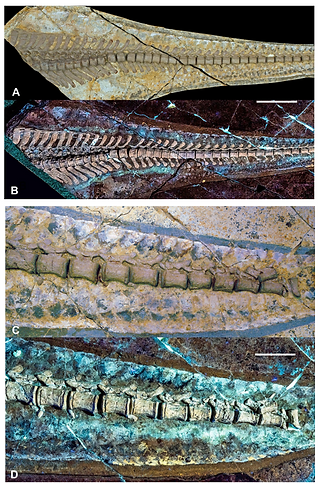
Haolong is an iguanodontian with porcupine-like quills preserved in the fossil specimen. Not technically feathers, these are actually highly modified scales down the dinosaur's back. The only known individual is a juvenile measuring 2.5 m in length, but adults likely grew larger. The unique integument raises more questions than answers in ornithopod biology.

Abstract from paper: The near-complete and articulated skeleton of a new iguanodontian dinosaur, Haolong dongi gen. et sp. nov., from the Lower Cretaceous of northeastern China, preserves exquisitely fossilized skin. The integument includes large overlapping scutate scales along the tail and tuberculate scales around the neck and thorax markedly different from the scale pattern described in other iguanodontians. Remarkably, these scales are interspersed with cutaneous spikes preserved at the cellular level. Tomographic and histological analyses reveal a hollow, cylindrical structure composed of a cornified stratum corneum overlying a pluristratified epidermis with keratinocytes preserved to the level of nuclei, surrounding a porous central dermal pulp. These spikes differ structurally from known protofeathers in non-avian dinosaurs and scaly spines in extant squamates, suggesting a distinct evolutionary origin. Their morphology and distribution imply a primary role in predator deterrence, with potential secondary functions in thermoregulation or mechanoreception. This discovery provides unprecedented insight into the microanatomy of non-avian dinosaur skin and highlights the complexity of skin evolution in ornithischian dinosaurs.



Haolong is from the Early Cretaceous. The Cretaceous is the third and final geological period of the Mesozoic Era, with the Early Cretaceous making up roughly the first half, lasting from about 143 to 100 million years ago. The poles were ice-free, due to the relatively warm climate, and forests extended into high latitudes. The continued breakup of the continents created new coastlines and isolated landmasses, influencing the evolution of distinct dinosaur faunas.
It was a time of transition, as many groups of animals and plants began to take on more modern forms while others declined or disappeared. Pterosaurs continued to thrive, though early birds were becoming more diverse and widespread. Mammals remained small but adapted to a variety of ecological niches. In the oceans, ichthyosaurs and plesiosaurs were common, and early mosasaurs began to appear.
Dinosaurs remained the dominant land animals, with groups like iguanodontians, spinosaurids, and carcharodontosaurids rising to prominence. While sauropods declined in some regions, they remained abundant in the Southern Hemisphere. The first true ceratopsians appeared, and ankylosaurs replaced stegosaurs in their niche. Dromaeosaurs and other small theropods diversified. During this time, the first flowering plants evolved, gradually changing global ecosystems by providing new food sources for herbivores.

Haolong is an iguanodontian. Iguanodontia was an important branch of the ornithopoda, a group of herbivorous dinosaurs that would become one of the most successful clades of the Cretaceous. These dinosaurs first appeared in the Late Jurassic as small bipedal grazers, but diversified through the Early Cretaceous, gradually increasing into larger more robust forms. While the more derived hadrosaurs of the Late Cretaceous became highly specialized for chewing tough plant material, basal iguanodontians retained a mix of primitive and advanced traits. They were among the first large-bodied ornithopods to spread widely across the Northern Hemisphere, with fossils found in Europe, North Africa, and Asia.
Early iguanodontians possessed powerful hind limbs for efficient bipedal movement but could also walk on all fours when foraging. One of their most distinctive features was their unique hand structure, which included a stiff, spike-like thumb that may have been used for defense or breaking apart tough vegetation. Although they lacked the fully developed dental batteries of later hadrosaurs, their teeth were already adapted for efficient plant processing, giving them an evolutionary advantage as herbivores. These adaptations laid the groundwork for the eventual dominance of hadrosaurs, which would expand into even more diverse habitats and continue to thrive until the end of the Cretaceous.


Comments