

Infernogallus
Updated: 2 days ago
MEANING: Hell chicken
PERIOD: Late Cretaceous
CONTINENT: North America
Infernogallus is an oviraptorosaurian theropod dinosaur from the Hell Creek formation of what is now North America. Small for a caenagnathid, it grew to approximately 1.5 m in body length and weighed an estimated 12 kg. Infernogallus is the first caenagnathid discovered with a nearly complete skull, which reveals it likely had a frugivorous, or fruit-eating diet.

Abstract from paper: The diversification of herbivorous dinosaurs and the rise of angiosperms in the Late Cretaceous are each well established, but the link between them is debated. Broad-scale diversity patterns in the two groups appear not to closely align, and there is no direct evidence of dinosaur adaptation to angiosperm-based diets. Here we describe Infernogallus jamesi gen. et. sp. nov., a diminutive caenagnathid oviraptorosaur, and show that these theropods were specialised herbivores that originated alongside the rise of fleshy angiosperm fruits. The nearly complete, articulated skull of Infernogallus jamesi—the first for the clade—reveals drastic changes to the adductor musculature organisation, unique in non-avian theropods but converged upon by extant frugivorous parrots. These modifications enabled extensive oral processing of soft food using anteroposterior movement of the mandible and occlusion of ridges and grooves on opposed elements. Altogether, this attests to a highly specialised herbivorous diet in caenagnathids, which likely consisted in large part of fleshy angiosperm fruits, which increased in size and diversity in concert with the radiation of oviraptorosaurs. Caenagnathids thus provide one of the strongest candidates for angiosperm-based diet adaptations in dinosaurs, but their role in the Late Cretaceous proliferation of fruit—which shaped early Cenozoic flora—remains unclear.

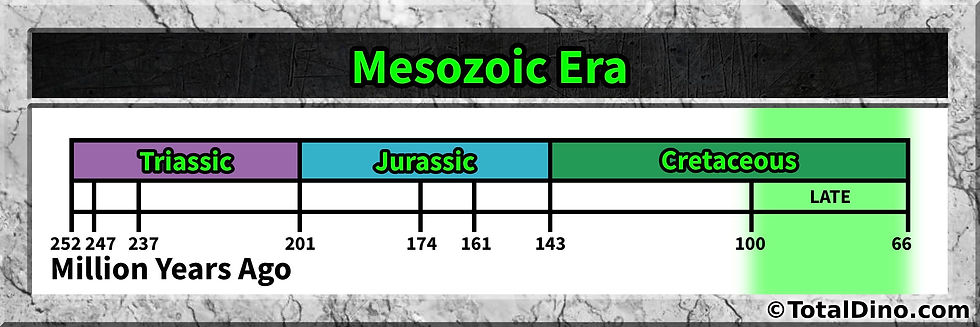
Infernogallus is from the Late Cretaceous. The Cretaceous is the third and final geological period of the Mesozoic Era, with the Late Cretaceous making up roughly the second half of it, lasting from about 100 to 66 million years ago. It was a time of significant evolutionary change, with dinosaurs reaching their greatest diversity before the mass extinction at the end of the Cretaceous.
The Cretaceous was a period with a relatively warm climate, though the Late Cretaceous experienced a global cooling trend, caused by falling levels of carbon dioxide in the atmosphere. The continents were nearing their present positions, but high sea levels flooded low-lying regions, turning Europe into an archipelago, and forming the Western Interior Seaway in North America. These seas were home to a variety of marine reptiles, including mosasaurs and plesiosaurs, while pterosaurs and birds shared the skies.
On land, dinosaurs continued to thrive and diversify during the Late Cretaceous, producing many of the most well-known goups, including tyrannosaurs, hadrosaurs, and pachycephalosaurs. Established Cretaceous dinosaur clades like the ceratopsians, ankylosaurs, and dromaeosaurs continued to flourish. Sauropod species consisted almost exclusively of titanosaurs, which seemed to be confined to the Southern Hemisphere for much of the Late Cretaceous. Flowering plants and grasses diversified and spread, becoming the dominant flora similar to what we see today.
The Cretaceous (along with the Mesozoic) ended with the Cretaceous-Paleogene (K-Pg) extinction event, a large mass extinction in which many groups, including non-avian dinosaurs, pterosaurs, and large marine reptiles, died out. This event, likely triggered by an asteroid impact, is marked by the abrupt K-Pg boundary, a distinct geologic layer separating the Mesozoic and Cenozoic Eras. In its aftermath, mammals and avian dinosaurs rapidly diversified, becoming the dominant land animals of the Cenozoic Era.
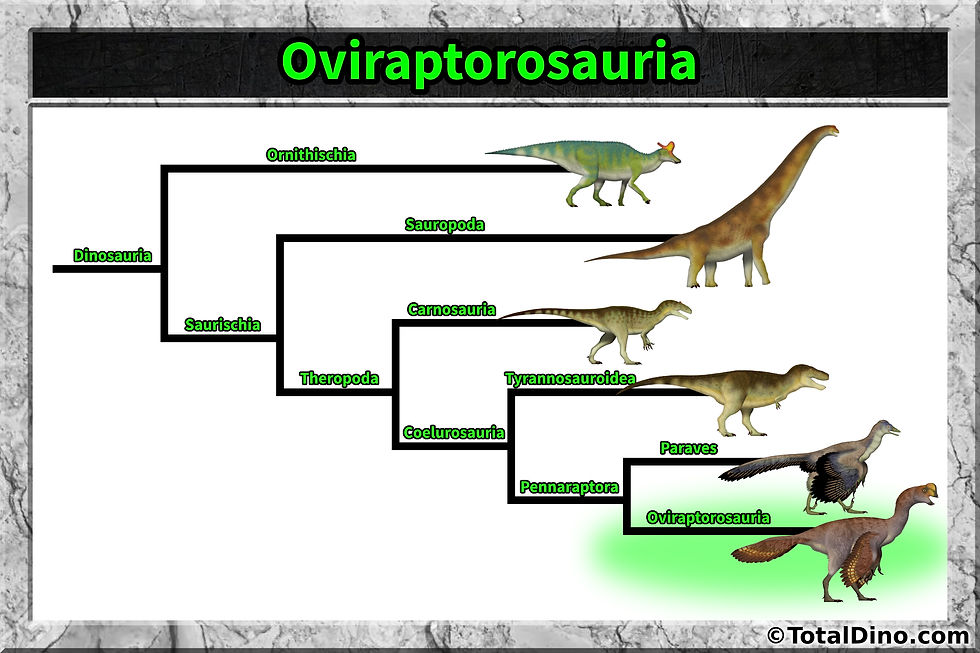
Infernogallus is an oviraptorosaur. Oviraptorosauria is a group of feathered theropod dinosaurs that lived during the Cretaceous Period and are known for their unusual, often bird-like anatomy. These dinosaurs were part of the larger clade Pennaraptora, which also includes birds, dromaeosaurs, and troodontids, and they show a mosaic of primitive and advanced traits that highlight their close relationship with birds.
Physically, oviraptorosaurs are characterized by their short, beaked snouts, often lacking teeth or bearing only a few reduced teeth at the front of the jaws. Many had elaborate cranial crests, which may have been used for display or species recognition. Their hands were relatively short but powerful, and their arms were often covered in feathers. Oviraptorosaurs were bipedal and typically had long legs suited for walking or running, with tails often stiffened by elongated vertebrae, possibly for balance or display. Fossils show that their plumage was not limited to basic fuzz but included complex feathering, similar to modern birds.
Oviraptorosaurs ranged in size from small species barely a meter long to much larger animals, including some over three meters in length. Their diet is still debated: some were likely herbivorous or omnivorous, using their strong, toothless beaks to process a variety of plant material, eggs, shellfish, or small animals. The discovery of nesting adults on top of egg clutches - some with embryonic remains inside - has given paleontologists valuable insight into their reproductive behavior, which appears to have been highly bird-like. Altogether, oviraptorosaurs offer a remarkable look at the diversity and evolutionary experimentation occurring within the feathered dinosaurs of the Cretaceous.


Isn’t the nickname for the oviraptorian Anzu wyliei “the chicken from hell”?
Funny they straight up name this guy “Hell chicken”