

Lishulong
MEANING: Chestnut tree dragon
PERIOD: Early Jurassic
CONTINENT: Asia
Lishulong is a basal sauropodomorph from the Early Jurassic. Typical of the sauropodomorphs of that time, Lishulong was a bipedal herbivore with a proportionately small head atop a long neck. Its teeth and neck suggest it likely fed on both ground-level and mid-height vegetation. Lishulong measured around 11 m in length, and weighed about 3 t.

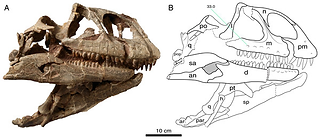
Abstract from paper: The Lower Jurassic Lufeng Formation of China has long been recognized for its diverse early-diverging sauropodomorph dinosaurs, with eight genera and ten species, representing more than half the Laurasian records. In this paper, we describe a new genus and species of non-sauropodan sauropodomorph, Lishulong wangi gen. et sp. nov., from Yunnan Province in southwestern China. This new taxon is represented by a partial skeleton including the skull and nine articulated cervical vertebrae, which differs from other Lufeng forms in both cranial and cervical characteristics. It bears several autapomorphies of the nasal process, the maxillary neurovascular foramen, and the cervical neural spine. Phylogenetic analysis reveals that Lishulong is an early-diverging member of the Sauropodiformes, and the sister-taxon of Yunnanosaurus. Elucidating the novel osteology of Lishulong, it possessed the largest sauropodomorph cranial material currently identified from the Lufeng Formation, not only enriches the diversity of the Lufeng dinosaur assemblage, but also enhances our understanding of the character evolution in early-diverging sauropodiforms. Furthermore, information about paleobiogeographic distributions indicates that Early Jurassic sauropodomorphs, especially Chinese taxa, have maintained multiple dispersions and exchanges within Pangaea.


Lishulong is from the Early Jurassic. The Jurassic Period, the second period of the Mesozoic Era, spanned from about 201 to 145 million years ago. It followed the Triassic-Jurassic extinction event, which cleared the way for new groups of organisms to rise and diversify - especially the dinosaurs. This extinction, likely caused by massive volcanic activity related to the breakup of the supercontinent Pangea, triggered climate shifts and widespread ecological upheaval. In the aftermath, the Early Jurassic began as a time of recovery and opportunity, where surviving lineages began to spread into newly vacated ecological roles.
During the Early Jurassic, Pangea was still largely intact, but rifting had begun in earnest, especially in the northern hemisphere. This led to the formation of new coastlines and the early stages of the Atlantic Ocean. Global climates were warm and relatively stable, with no evidence of polar ice. In many regions, lush forests of ferns, cycads, ginkgoes, and conifers flourished. These plants formed the backbone of early Jurassic ecosystems and provided food for a growing diversity of herbivorous dinosaurs.
Dinosaurs, which had first appeared in the Late Triassic, truly began to establish dominance during this time. Early sauropods like began evolving larger body sizes and more efficient quadrupedal locomotion, paving the way for the giants of the Late Jurassic. Theropods such filled the role of medium-to-large predators, while small ornithischians scurried below the forest canopy. Although these groups were still relatively primitive compared to their later descendants, the foundations of major Mesozoic lineages were already being laid in the Early Jurassic. The period set the stage for an explosion of diversity and gigantism that would characterize the rest of the Jurassic world.

Lishulong is a basal sauropodomorph. Sauropodomorpha is the larger group that contains the long-necked sauropod dinosaurs. Basal sauropodomorphs, often informally referred to as "prosauropods," were early members of the lineage that eventually gave rise to the massive quadrupedal herbivores. These early sauropodomorphs thrived during the Late Triassic and Early Jurassic periods and represent some of the first large-bodied plant-eaters to evolve within Dinosauria. They were generally medium-sized, with long necks, small heads, and leaf-shaped teeth suited for a herbivorous or omnivorous diet.
Unlike their gigantic descendants, most basal sauropodomorphs were primarily bipedal, though some likely used all four limbs when moving slowly or feeding. Their forelimbs were shorter than their hindlimbs, and many had grasping hands with large claws - features that suggest a degree of versatility in both locomotion and feeding behavior. Fossil evidence of these dinosaurs has been found across much of Pangea, showing they were among the earliest dinosaur groups to achieve a widespread distribution. Though often overshadowed by the sauropods they gave rise to, these early forms played a crucial role in the rise of large-bodied herbivores and the overall success of dinosaurs in the Mesozoic.


Comments