

Phosphatotitan
Updated: Apr 30
MEANING: Phosphate giant
PERIOD: Late Cretaceous
CONTINENT: Africa
Phosphatotitan is a titanosaurian sauropod dinosaur from what is now Morocco. It is most closely related to South American titanosaurs, indicating Late Cretaceous titanosaur diversity in the Southern Hemisphere may be underestimated. Smaller than its South American counterparts, Phosphatotitan is estimated at around 4 t in total body mass.

Abstract from paper: The latest Cretaceous saw the final diversification of dinosaurs before the K/Pg extinction. Discussions of end-Cretaceous dinosaur diversity have focused on well-sampled faunas from Laurasia; far less is known about dinosaurian faunas of the Southern Hemisphere, especially Africa. The late Maastrichtian Phosphates of Morocco provide a rare window into African dinosaur diversity. Abelisaurids, lambeosaurines, and titanosaurian sauropods are known. However, no diagnostic titanosaur remains have been recovered, leaving the affinities of these sauropods unclear. We describe Phosphatotitan khouribgaensis gen. et sp. nov., a new titanosaur from the Maastrichtian of Sidi Chennane, Khouribga Province. Phosphatotitan is represented by dorsal, sacral, and caudal vertebrae, and the pelvis. The new species differs from titanosaurs described from the Cretaceous of Africa and Europe but resembles South American Lognkosauria, and especially Patagotitan, in having short dorsal and caudal centra, expanded dorsal and caudal neural spines, and a broad pubis. Its small size relative to other Lognkosauria (3.5–4 tonnes) suggests a lineage selected for small size. The close relationships of Morocco’s titanosaurs and abelisaurids to South American species may reflect a wide distribution of these clades prior to the opening of the South Atlantic and the separation of Africa and South America ~100 Ma, while a complex pattern of oceanic dispersal may explain the presence of distinct saltasauroid lineages worldwide. The latest Cretaceous Gondwanan dinosaur faunas were highly endemic due to a combination of continental fragmentation, extinction, and dispersal, creating high endemism in southern continents and within Africa, suggesting that Maastrichtian dinosaur diversity is underestimated.

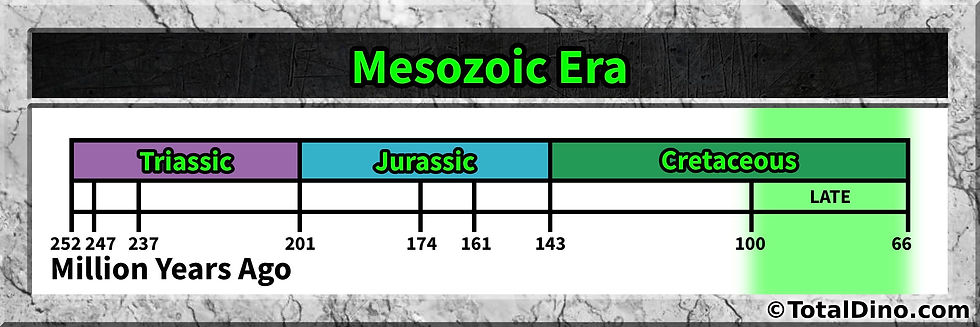
Phosphatotitan is from the Late Cretaceous. The Cretaceous is the third and final geological period of the Mesozoic Era, with the Late Cretaceous making up roughly the second half of it, lasting from about 100 to 66 million years ago. It was a time of significant evolutionary change, with dinosaurs reaching their greatest diversity before the mass extinction at the end of the Cretaceous.
The Cretaceous was a period with a relatively warm climate, though the Late Cretaceous experienced a global cooling trend, caused by falling levels of carbon dioxide in the atmosphere. The continents were nearing their present positions, but high sea levels flooded low-lying regions, turning Europe into an archipelago, and forming the Western Interior Seaway in North America. These seas were home to a variety of marine reptiles, including mosasaurs and plesiosaurs, while pterosaurs and birds shared the skies.
On land, dinosaurs continued to thrive and diversify during the Late Cretaceous, producing many of the most well-known goups, including tyrannosaurs, hadrosaurs, and pachycephalosaurs. Established Cretaceous dinosaur clades like the ceratopsians, ankylosaurs, and dromaeosaurs continued to flourish. Sauropod species consisted almost exclusively of titanosaurs, which seemed to be confined to the Southern Hemisphere for much of the Late Cretaceous. Flowering plants and grasses diversified and spread, becoming the dominant flora similar to what we see today.
The Cretaceous (along with the Mesozoic) ended with the Cretaceous-Paleogene (K-Pg) extinction event, a large mass extinction in which many groups, including non-avian dinosaurs, pterosaurs, and large marine reptiles, died out. This event, likely triggered by an asteroid impact, is marked by the abrupt K-Pg boundary, a distinct geologic layer separating the Mesozoic and Cenozoic Eras. In its aftermath, mammals and avian dinosaurs rapidly diversified, becoming the dominant land animals of the Cenozoic Era.
Phosphatotitan is a lognkosaurian titanosaur. Lognkosaurians are a family of large-bodied titanosaurs that include some of the largest land animals known to science. This group is primarily known from South America, particularly Argentina, where many of these colossal sauropods have been discovered.
Lognkosaurians are characterized by their massive size and distinctive body proportions. They had extremely long necks with highly elongated vertebrae, wide cervical ribs, and robust, barrel-shaped torsos. These features suggest adaptations for supporting a horizontally extensive feeding range, possibly allowing them to graze or browse across large swaths of vegetation without needing to move their entire bodies frequently.
They arose at the end of the Early Cretaceous and lived primarily through the Late Cretaceous, a period when titanosaurs were the dominant sauropods in the Southern Hemisphere. While other sauropod lineages had declined or disappeared in many parts of the world, lognkosaurians continued to thrive, representing a highly specialized and extreme branch of titanosaur evolution.


Comments