

Rinconraptor
MEANING: Rincón thief
PERIOD: Late Cretaceous
CONTINENT: South America
Rinconraptor is a medium-sized megaraptoran theropod dinosaur, growing to approximately 7 m in total body length. It was a bipedal carnivore with proportionately long arms, each ending in three long claws. An enigmatic group, Rinconraptor's discovery helped to reinforce the idea that megaraptorans were closely related to tyrannosaurs.
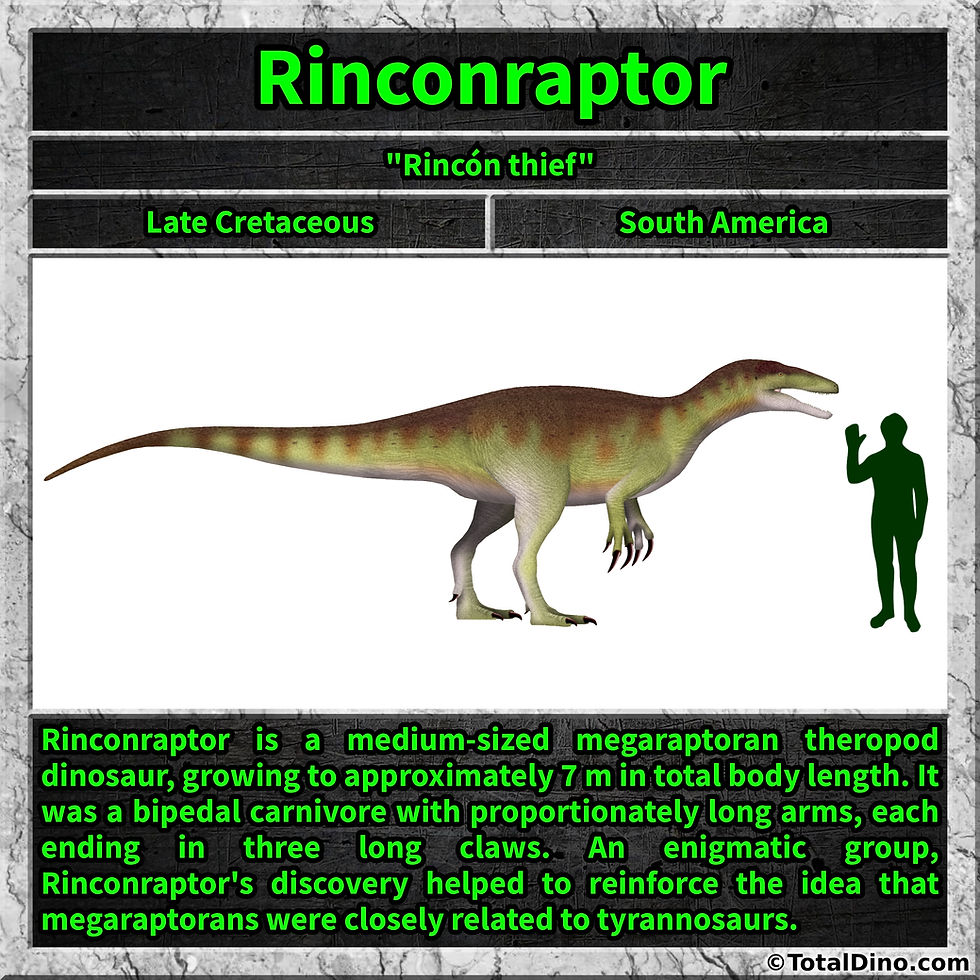
Abstract from paper: The megaraptorids are a clade of medium- to large-sized theropods that are still relatively poorly known in terms of their morphology, phylogenetic relationships, macroevolutionary trends, and biogeographic dispersal patterns. We present a new representative of the family Megaraptoridae, Rinconraptor pipoae gen. et sp. nov., which is characterized by an ectepicondyle being positioned far from the distal end of the humerus, cnemial crest, and medial condyle of the tibia with a subquadrangular shape, presence of an anterodistal ridge on the humerus, and incisura tibialis forming a right angle. Furthermore, we describe other skeletal remains of several indeterminate specimens of the same clade, all recovered from the Cerro Overo-La Invernada area (Neuquén Basin). Phylogenetic analyses support the existence of a monophyletic subclade of South American megaraptorids. The analysis of caudal vertebrae morphology reinforces the hypothesis of a phylogenetic relationship and shared morphological patterns between megaraptorans and tyrannosauroids. The new materials support the evolutionary trend of increasing body size during the Late Cretaceous. The rich terrestrial ecosystem of the Cerro Overo-La Invernada area would have been composed of peirosaurid crocodyliforms, chelid turtles, elasmarian ornithopods, titanosaur sauropods and theropods, such as abelisaurids and megaraptorids, which served as apex predators.


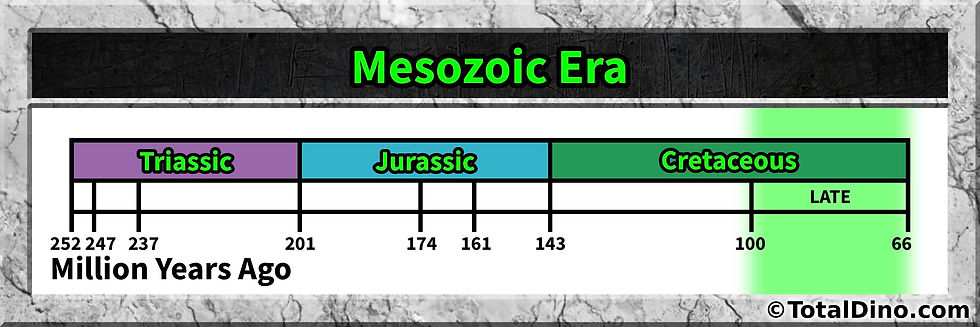
Rinconraptor is from the Late Cretaceous. The Cretaceous is the third and final geological period of the Mesozoic Era, with the Late Cretaceous making up roughly the second half of it, lasting from about 100 to 66 million years ago. It was a time of significant evolutionary change, with dinosaurs reaching their greatest diversity before the mass extinction at the end of the Cretaceous.
The Cretaceous was a period with a relatively warm climate, though the Late Cretaceous experienced a global cooling trend, caused by falling levels of carbon dioxide in the atmosphere. The continents were nearing their present positions, but high sea levels flooded low-lying regions, turning Europe into an archipelago, and forming the Western Interior Seaway in North America. These seas were home to a variety of marine reptiles, including mosasaurs and plesiosaurs, while pterosaurs and birds shared the skies.
On land, dinosaurs continued to thrive and diversify during the Late Cretaceous, producing many of the most well-known goups, including tyrannosaurs, hadrosaurs, and pachycephalosaurs. Established Cretaceous dinosaur clades like the ceratopsians, ankylosaurs, and dromaeosaurs continued to flourish. Sauropod species consisted almost exclusively of titanosaurs, which seemed to be confined to the Southern Hemisphere for much of the Late Cretaceous. Flowering plants and grasses diversified and spread, becoming the dominant flora similar to what we see today.
The Cretaceous (along with the Mesozoic) ended with the Cretaceous-Paleogene (K-Pg) extinction event, a large mass extinction in which many groups, including non-avian dinosaurs, pterosaurs, and large marine reptiles, died out. This event, likely triggered by an asteroid impact, is marked by the abrupt K-Pg boundary, a distinct geologic layer separating the Mesozoic and Cenozoic Eras. In its aftermath, mammals and avian dinosaurs rapidly diversified, becoming the dominant land animals of the Cenozoic Era.
Rinconraptor is a megaraptoran. Megaraptora is a group of large predatory theropods that lived during the Cretaceous Period. They were most diverse in South America, but they had a widespread distribution. Despite their name, megaraptorans are not closely related to the smaller dromaeosaur “raptors”. Instead, they represent a distinct lineage of large-bodied predators that occupied apex roles in their ecosystems, though their exact phylogenetic affinities are not clear. Different studies place them among coelurosaurs, carnosaurs, or as a distinct branch within allosauroid theropods, reflecting ongoing uncertainty in their phylogenetic relationships.
The most distinctive feature of megaraptorans is the enlarged, recurved claws on their forelimbs, which in some species exceeded 30 centimeters in length. These claws, combined with long, powerful arms and lightly built skeletons, suggest they were agile hunters that relied heavily on grasping and slashing during predation. Their skulls were relatively lightly built compared to other large theropods, and they likely used their forelimbs as their primary weapons. Fossil evidence indicates they persisted into the Late Cretaceous, making them some of the last surviving large predatory dinosaurs in the Southern Hemisphere.


Comments