

Stegouros
MEANING: Roofed tail
PERIOD: Late Cretaceous
CONTINENT: South America
Stegouros is a small, early-diverging ankylosaurian dinosaur in the parankylosauria family. It was a small quadrupedal herbivore at about 1.5 meters in length, with osteoderms along its back. The short tail of Stegouros had distinctive axe-like spikes protruding from either side, rather than the more common tail club found in derived ankylosaurids.

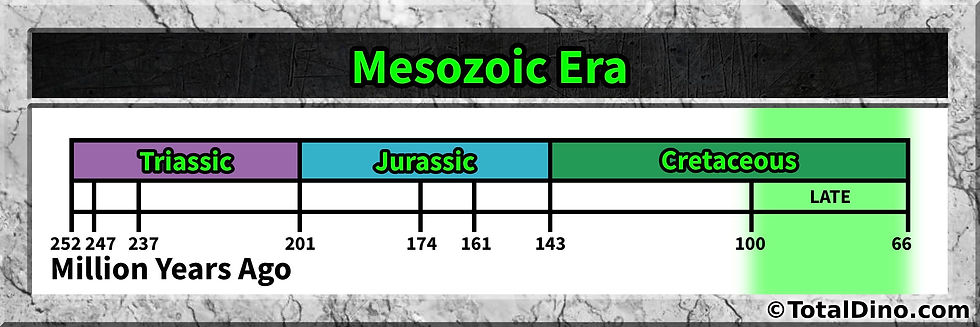
Stegouros is from the Late Cretaceous. The Cretaceous is the third and final geological period of the Mesozoic Era, with the Late Cretaceous making up roughly the second half of it, lasting from about 100 to 66 million years ago. It was a time of significant evolutionary change, with dinosaurs reaching their greatest diversity before the mass extinction at the end of the Cretaceous.
The Cretaceous was a period with a relatively warm climate, though the Late Cretaceous experienced a global cooling trend, caused by falling levels of carbon dioxide in the atmosphere. The continents were nearing their present positions, but high sea levels flooded low-lying regions, turning Europe into an archipelago, and forming the Western Interior Seaway in North America. These seas were home to a variety of marine reptiles, including mosasaurs and plesiosaurs, while pterosaurs and birds shared the skies.
On land, dinosaurs continued to thrive and diversify during the Late Cretaceous, producing many of the most well-known goups, including tyrannosaurs, hadrosaurs, and pachycephalosaurs. Established Cretaceous dinosaur clades like the ceratopsians, ankylosaurs, and dromaeosaurs continued to flourish. Sauropod species consisted almost exclusively of titanosaurs, which seemed to be confined to the Southern Hemisphere for much of the Late Cretaceous. Flowering plants and grasses diversified and spread, becoming the dominant flora similar to what we see today.
The Cretaceous (along with the Mesozoic) ended with the Cretaceous-Paleogene (K-Pg) extinction event, a large mass extinction in which many groups, including non-avian dinosaurs, pterosaurs, and large marine reptiles, died out. This event, likely triggered by an asteroid impact, is marked by the abrupt K-Pg boundary, a distinct geologic layer separating the Mesozoic and Cenozoic Eras. In its aftermath, mammals and avian dinosaurs rapidly diversified, becoming the dominant land animals of the Cenozoic Era.
Stegouros is an ankylosaur. Ankylosauria is a group of herbivorous, armored ornithischian dinosaurs known for their heavily built bodies and protective coverings. The group is traditionally divided into two main families: the tail-club-wielding Ankylosauridae and the spike-covered Nodosauridae. These derived forms are well known from the Cretaceous, and represent the height of ankylosaur evolution in terms of defensive adaptations and body size. However, the evolutionary story of ankylosaurs begins earlier, with more basal forms that lack many of the extreme traits seen in their later relatives.
Basal ankylosaurians were generally smaller and less heavily armored than their descendants. While they still possessed osteoderms embedded in their skin, these were arranged in simpler patterns and offered more modest protection. These early members often retained more gracile builds and longer limbs, suggesting they may have been slightly more agile and less tank-like. Many lacked the wide skulls, fused body armor, and tail clubs seen in ankylosaurids, and some retained relatively primitive features like simple teeth and unspecialized hips. Fossils of these basal forms are known from both the Jurassic and Early Cretaceous, and they provide crucial insight into how ankylosaurs gradually developed their hallmark traits over time.


Comments