

Titanomachya
Updated: Oct 24, 2025
MEANING: Titanomachy
PERIOD: Late Cretaceous
CONTINENT: South America
Titanomachya is a titanosaurian sauropod from the Late Cretaceous of what is now South America. The name alludes to the battle in which the mythological Greek Titans were defeated, as a reference to being near the extinction of the titanosaurs. Titanomachya is extremely small for a titanosaur, at only 6 m in length, and weighing about 8 t in body mass.

Abstract from paper: Knowledge of the Campanian-Maastrichtian titanosaurian sauropods from southern South America has increased markedly in recent years. Several taxa have been reported from northern Patagonia, as well as few taxa from southern Patagonia that were described in the last years. However, titanosaurs from the end-Cretaceous of Central Patagonia are poorly known. Here we report the associated remains of a new species of a titanosaurian sauropod from the La Colonia Formation found in northern Chubut Province. Titanomachya gimenezi gen. et sp. nov. is represented by a caudal vertebra and appendicular elements. Titanomachya, is interpreted as a member of Lithostrotia, sharing derived features with saltasaurids and bearing unique characteristics in the astragalus. The astragalus morphology of Titanomachya display an intermediate form between Colossosauria and Saltasauroidea, allowing articulation between zeugopodium and autopodium with contributions from both the tibia and fibula. The type specimen is a small-sized adult, estimated at 5.8–9.8 tons. Comparative analyses reveal distinct sauropod faunas in different Patagonian regions and Brazilian formations during the Campanian – Maastrichtian. In northern Patagonia, aeolosaurines and saltasaurines predominate, while in southern Patagonia predominate colossosaurians and other large titanosaurs. The less well-known sauropod fauna from central Patagonia includes aeolosaurines, eutitanosaurs, and the addition of small-bodied saltasauroids such as Titanomachya.


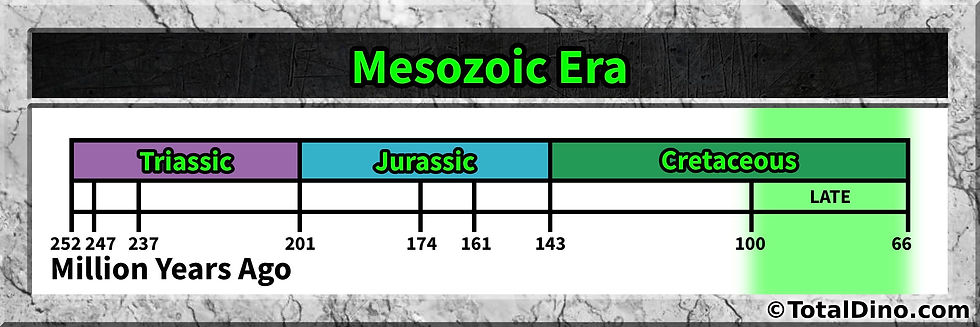
Titanomachya is from the Late Cretaceous. The Cretaceous is the third and final geological period of the Mesozoic Era, with the Late Cretaceous making up roughly the second half of it, lasting from about 100 to 66 million years ago. It was a time of significant evolutionary change, with dinosaurs reaching their greatest diversity before the mass extinction at the end of the Cretaceous.
The Cretaceous was a period with a relatively warm climate, though the Late Cretaceous experienced a global cooling trend, caused by falling levels of carbon dioxide in the atmosphere. The continents were nearing their present positions, but high sea levels flooded low-lying regions, turning Europe into an archipelago, and forming the Western Interior Seaway in North America. These seas were home to a variety of marine reptiles, including mosasaurs and plesiosaurs, while pterosaurs and birds shared the skies.
On land, dinosaurs continued to thrive and diversify during the Late Cretaceous, producing many of the most well-known groups, including tyrannosaurs, hadrosaurs, and pachycephalosaurs. Established Cretaceous dinosaur clades like the ceratopsians, ankylosaurs, and dromaeosaurs continued to flourish. Sauropod species consisted almost exclusively of titanosaurs, which seemed to be confined to the Southern Hemisphere for much of the Late Cretaceous. Flowering plants and grasses diversified and spread, becoming the dominant flora similar to what we see today.
The Cretaceous (along with the Mesozoic) ended with the Cretaceous-Paleogene (K-Pg) extinction event, a large mass extinction in which many groups, including non-avian dinosaurs, pterosaurs, and large marine reptiles, died out. This event, likely triggered by an asteroid impact, is marked by the abrupt K-Pg boundary, a distinct geologic layer separating the Mesozoic and Cenozoic Eras. In its aftermath, mammals and avian dinosaurs rapidly diversified, becoming the dominant land animals of the Cenozoic Era.
Titanomachya is a saltasauroid titanosaur. Saltasauroids are a clade of derived titanosaurs that thrived during the Late Cretaceous and are among the last and most specialized members of the sauropod lineage. They are primarily known from South America, though fossils have also been found in Asia and elsewhere. These sauropods tended to be smaller and more compact than their earlier relatives, with some species estimated to have been under 15 meters in length - small by sauropod standards. Despite their reduced size, they retained the characteristic long necks and tails of their lineage.
One of the most distinctive traits of saltasauroids is the presence of bony armor, or osteoderms, embedded in their skin - a rare feature among sauropods. This dermal armor suggests a possible evolutionary response to increased predation pressures during the Late Cretaceous. Their skeletons often show adaptations toward a more robust and stocky build, possibly indicating changes in locomotion or lifestyle compared to earlier titanosaurs. As one of the last surviving sauropod groups before the end-Cretaceous extinction, saltasauroids represent the final phase in the long evolutionary history of these giant herbivores.


Comments