

Tromerosaurus
Updated: 10 hours ago
MEANING: Terrible lizard
PERIOD: Late Cretaceous
CONTINENT: North America
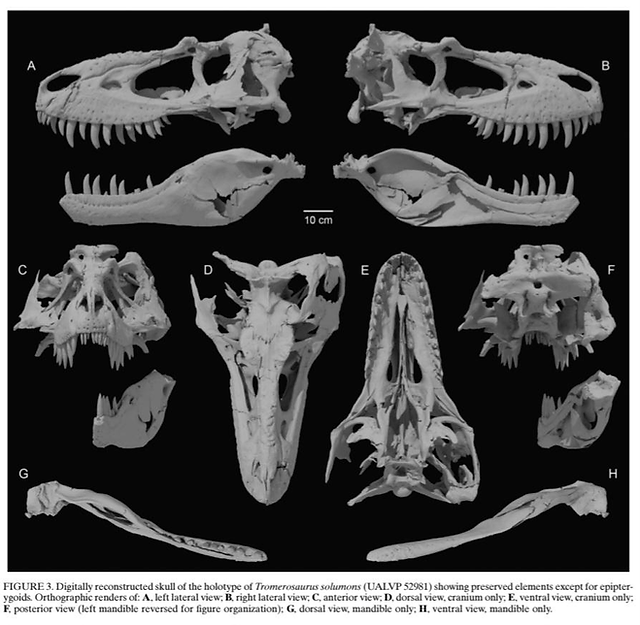
Tromerosaurus is a medium-sized tyrannosaur that lived during the Late Cretaceous period in what is now Canada. It was a bipedal carnivore that grew to approximately 7 m in total body length. Tromerosaurus had many intermediate traits found among contemporary tyrannosaurs, revealing insight about how different lineages diverged and coexisted.

Abstract from paper: Tyrannosaurid species have often been considered to have high longevity and low diversity relative to contemporaneous megaherbivores. Recent chronospecies assertions around tyrannosaurid lineage evolution have reinforced this idea. An albertosaurine, Tromerosaurus solumons, from the Oldman Formation of Alberta, Canada, shares features with Daspletosaurus and Gorgosaurus, and prompts reassessment of tyrannosaurid characteristics and the Late Cretaceous radiation of Tyrannosauridae. Maxillary morphometrics reveal clear intermediate morphologies in Tromerosaurus between Daspletosaurus and Gorgosaurus, including an anteroposteriorly longer maxillary fenestra and narrower pila promaxillaris than in Gorgosaurus libratus. An anatomical diagnosis of Tromerosaurus solumons allowed referral of specimens previously attributed to Gorgosaurus. Restricted stratigraphic overlap between Tromerosaurus and Gorgosaurus offers support to this distinction. A modified recent character-taxon dataset recovers Tromerosaurus as the earliest diverging member of Albertosaurinae under parsimony or Tyrannosaurinae under Bayesian inference. The difference in topologies along with reduced node support values for clades such as Lythronax + Teratophoneus, or Bistahieversor and other derived tyrannosaurines, suggests uncertainty as to their recovery within Albertosaurinae or Tyrannosaurinae. Together, these results support a younger divergence of the two main tyrannosaurid lineages with rapid character acquisition and transition during the Late Cretaceous (Santonian–Maastrichtian).



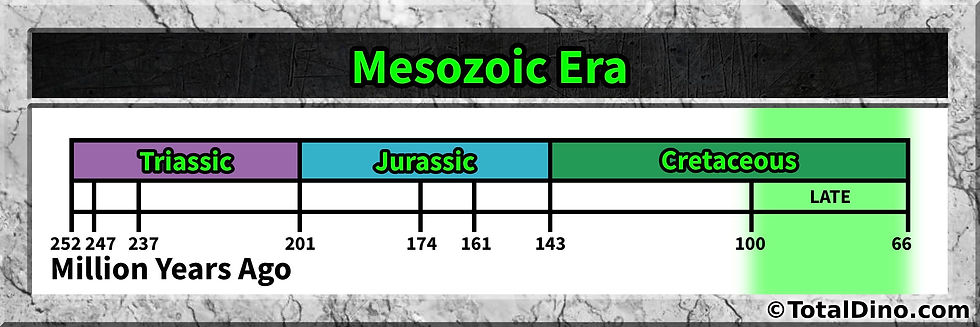
Tromerosaurus is from the Late Cretaceous. The Cretaceous is the third and final geological period of the Mesozoic Era, with the Late Cretaceous making up roughly the second half of it, lasting from about 100 to 66 million years ago. It was a time of significant evolutionary change, with dinosaurs reaching their greatest diversity before the mass extinction at the end of the Cretaceous.
The Cretaceous was a period with a relatively warm climate, though the Late Cretaceous experienced a global cooling trend, caused by falling levels of carbon dioxide in the atmosphere. The continents were nearing their present positions, but high sea levels flooded low-lying regions, turning Europe into an archipelago, and forming the Western Interior Seaway in North America. These seas were home to a variety of marine reptiles, including mosasaurs and plesiosaurs, while pterosaurs and birds shared the skies.
On land, dinosaurs continued to thrive and diversify during the Late Cretaceous, producing many of the most well-known groups, including tyrannosaurs, hadrosaurs, and pachycephalosaurs. Established Cretaceous dinosaur clades like the ceratopsians, ankylosaurs, and dromaeosaurs continued to flourish. Sauropod species consisted almost exclusively of titanosaurs, which seemed to be confined to the Southern Hemisphere for much of the Late Cretaceous. Flowering plants and grasses diversified and spread, becoming the dominant flora similar to what we see today.
The Cretaceous (along with the Mesozoic) ended with the Cretaceous-Paleogene (K-Pg) extinction event, a large mass extinction in which many groups, including non-avian dinosaurs, pterosaurs, and large marine reptiles, died out. This event, likely triggered by an asteroid impact, is marked by the abrupt K-Pg boundary, a distinct geologic layer separating the Mesozoic and Cenozoic Eras. In its aftermath, mammals and avian dinosaurs rapidly diversified, becoming the dominant land animals of the Cenozoic Era.
Tromerosaurus is a tyrannosaur. Tyrannosauroidea is a group of theropod dinosaurs known for often being the largest predators in their ecosystems, at the top of the food chain. They evolved throughout the Cretaceous, starting as relatively small predators before giving rise to some of the largest carnivores to ever walk the Earth. Early tyrannosaurs from the Jurassic and Early Cretaceous were generally small-bodied and built for speed, with long arms and three-fingered hands. Some of these early forms are known to have been feathered. Early tyrannosaurs lived alongside larger predatory dinosaurs like carcharodontosaurs, which dominated apex predator niches in many regions.
As the Cretaceous progressed, tyrannosaurs gradually increased in size, with later forms evolving more robust skulls, stronger bite forces, and reduced arms. By the Late Cretaceous, the most derived members of the group had become massive apex predators with thick, deep skulls specialized for crushing bone. These tyrannosaurids had only two functional fingers on each hand, a trait that distinguished them from earlier relatives. By this time, tyrannosaurs had largely replaced other large theropods in North America and Asia, cementing their role as dominant predators by the end of the Mesozoic.


Comments