

Uragasaurus
MEANING: Serpent lizard
PERIOD: Late Jurassic
CONTINENT: Asia
Uragasaurus is a sauropod dinosaur, and the first mamenchisaurid known from Thailand. Mamenchisaurids exhibit the basic sauropod body plan, processing their herbivorous diet in their large gut. Uniquely, mamenchisaurid necks, like that of Uragasaurus, are proportionately long, even by sauropod standards.

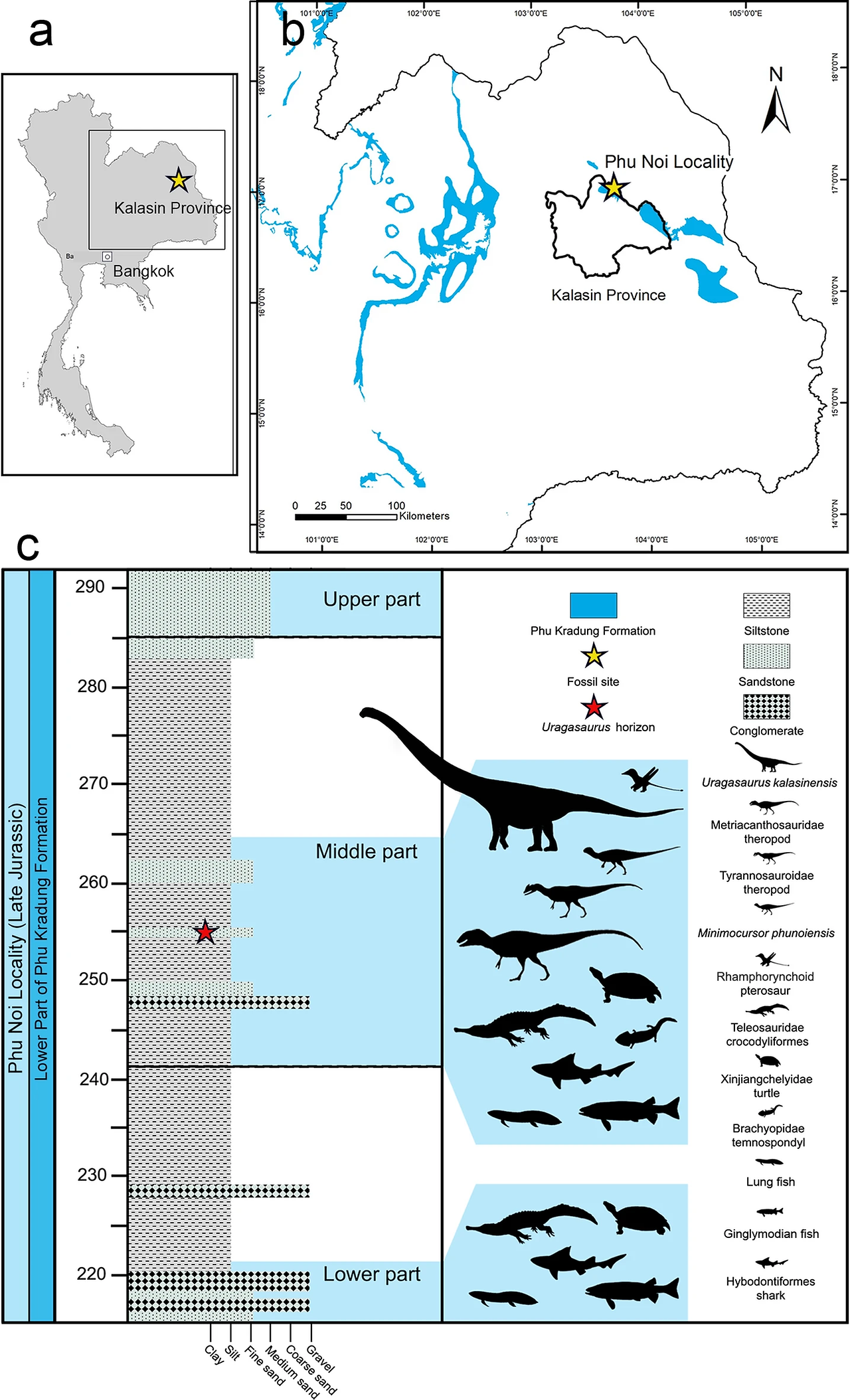
Abstract from paper: Mamenchisauridae is a group of long-necked non-neosauropodan eusauropod dinosaurs that were abundant in East Asia during the Middle to Late Jurassic, but their diversity and geographic distribution outside China remain poorly documented. Here we describe Uragasaurus kalasinensis gen. et sp. nov., a new sauropod dinosaur from the Phu Kradung Formation of northeastern Thailand. The new taxon is based on a well-preserved anterior dorsal vertebra exhibiting a distinctive combination of characters, including a unique Y-shaped configuration formed by the intraprezygapophyseal and single intraprezygapophyseal laminae and a camellate internal pneumatic structure within the centrum revealed by computed tomography (CT). Phylogenetic analyses recover the new taxon as an early-diverging member of Mamenchisauridae. This discovery represents the first formally named mamenchisaurid from Thailand and expands the known geographic distribution of the clade in Southeast Asia. The occurrence of this taxon in the Lower part of the Phu Kradung Formation also contributes to understanding faunal succession within the unit, supports an Upper Jurassic age for the lower part of the formation, and improves understanding of sauropod diversity in Southeast Asia during the Jurassic-Cretaceous transition.


Uragasaurus is from the Late Jurassic. The Late Jurassic was a dynamic period, spanning from about 162 to 143 million years ago. The continents were continuing to drift apart, and the supercontinent Pangaea had fully split into Laurasia in the north and Gondwana in the south. This continental rearrangement led to the formation of large inland seas and shallow coastlines that fostered diverse ecosystems. The climate during the Late Jurassic was warm and humid, with lush forests of conifers and ferns that stretched across much of the continents, creating a rich ecosystem where dinosaurs flourished the dominant land animals.
Dinosaurs continued to diversify through the Late Jurassic, with some of the most famous species evolving in this time. Many well-known sauropods, such as Brachiosaurus and Apatosaurus roamed the land, exhibiting niche partitioning with their selectively distinct neck positions. Alongside them, stegosaurs became widespread, their plates and spikes making them one of the era's most recognizable groups. Theropods like Allosaurus and Ceratosaurus were the apex predators, evolving large, powerful bodies and sharp teeth that allowed them to hunt the gigantic herbivores. The early evolution of birds was taking place, setting the stage for the numerous species that would fill the skies in the eras to come.
Unlike the dramatic mass extinctions that marked the beginning and end of the Mesozoic, the Jurassic Period ended without a sharp boundary. As the continents continued to drift, ecosystems gradually transformed into unique habitats that supported the more specialized dinosaur species of the Cretaceous.

Uragasaurus is a mamenchisaurid. Mamenchisauridae is a distinctive group of sauropod dinosaurs best known for their incredibly long necks, which proportionally outstretched those of nearly any other dinosaur. This clade is primarily known from the Jurassic Period of Asia, particularly China, where several well-preserved fossils have been discovered. Mamenchisaurids are unique for evolving some of the most extreme neck elongation seen in any terrestrial vertebrate, sometimes accounting for over half their total body length. Despite these massive necks, their bodies were relatively compact and lightly built compared to other long-necked sauropods.
Fossil evidence suggests that mamenchisaurids were relatively slow-moving, ground-feeding herbivores that relied on their extended necks to reach broad swaths of vegetation without needing to move their entire bodies. The structure of their cervical vertebrae shows adaptations for both strength and flexibility, likely allowing them to sweep their necks laterally across the landscape in search of low-lying plants. Though most commonly associated with the Late Jurassic of China, possible members of the group have also been found in Thailand, Africa, and even as far as South America, hinting at a wider geographic range and evolutionary influence than once thought. Mamenchisaurids represent an important branch of sauropod evolution - one that pushed the limits of neck elongation and feeding strategy in ways that remain the subject of ongoing scientific interest.


Comments