

Yantaloong
Updated: Feb 6
MEANING: Yanta dragon
PERIOD: Middle Jurassic
CONTINENT: Asia
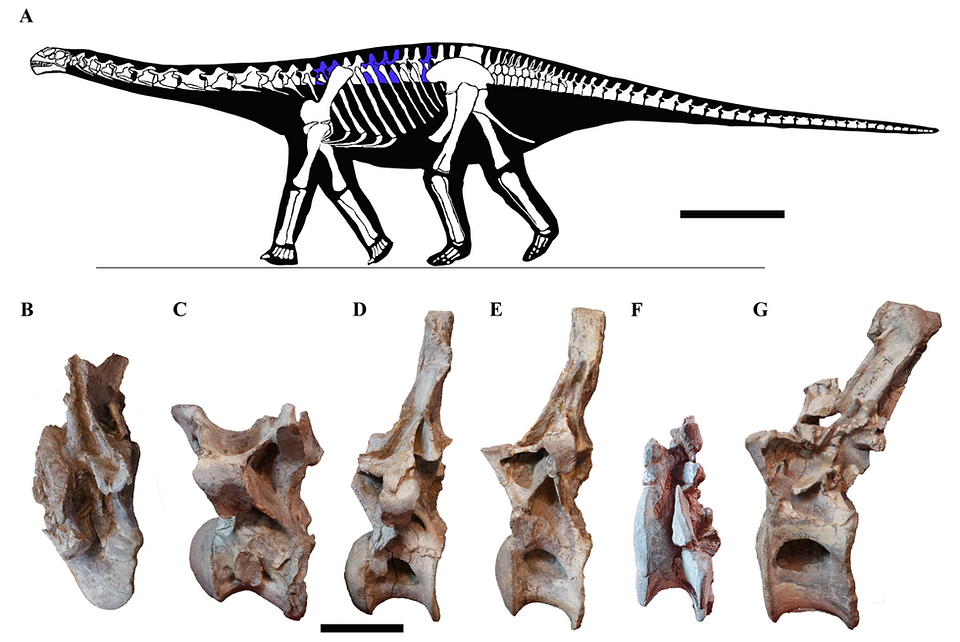
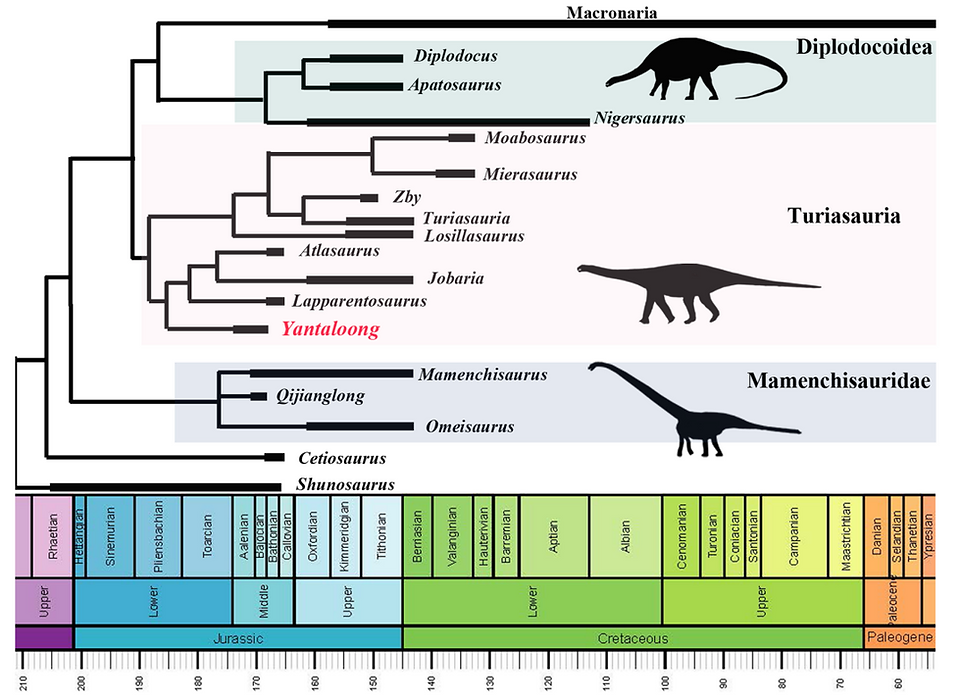
Yantaloong is a sauropod dinosaur whose curious phylogenetic affiliations raise more questions than they answer. It seems most likely to be in the Turiasauria family, more derived than Mamenchisauridae, but it may be a basal macronarian. If Yantaloong is indeed a turiasaur, it is the only one known from East Asia.

Abstract from paper: The Middle Jurassic of China hosts a diverse dinosaur fauna dominated by mamenchisaurid sauropods, along with some early diverging eusauropod and neosauropod members. However, no transitional taxa have been confirmed in East Asia along the evolutionary path from mamenchisaurids to neosauropods. Here, we describe a new sauropod represented by six presacral vertebrae, Yantaloong lini gen. et sp. nov., recovered from the Middle Jurassic Zhanghe Formation of Yunnan Province, China. Most of our phylogenetic analyses recover Yantaloong within a non-traditional Turiasauria clade (including Lapparentosaurus, Jobaria, and Atlasaurus). Alternatively, some of our analyses also suggest that Yantaloong could be a non-neosauropod eusauropod outside the traditional Turiasauria or as a member of Neosauropoda, although these conditions are less favoured. Yantaloong shows a unique mixture of derived characters typically seen in derived dicraeosaurinaes and even in titanosaurs, along with plesiomorphic traits characteristic of basal eusauropods. Yantaloong provides a better understanding of the vertebral morphological diversity in sauropods, such as the pneumatization and the hyposphene–hypantrum complex, which further supports its phylogenetic position as a form transitional towards Neosauropoda. Yantaloong probably represents the first discovery of a turiasaurian sauropod in China and even in East Asia.


Yantaloong is from the Middle Jurassic. The Middle Jurassic, spanning from approximately 174 to 163 million years ago, was a period of increasing tectonic activity and evolutionary innovation. By this time, the supercontinent Pangaea had begun to split more significantly, with Laurasia in the north and Gondwana in the south drifting apart. This movement created new coastlines, shallow seas, and rift valleys that fostered diverse ecosystems. The climate remained generally warm and humid, promoting the spread of lush vegetation, including ferns, cycads, and conifers, which blanketed much of the land and supported a wide variety of herbivorous dinosaurs.
Though less well known than the Late Jurassic, the Middle Jurassic was an important evolutionary chapter. Several major dinosaur groups began to diversify, including the stegosaurs and more derived long-necked sauropods that would later dominate the landscape. Theropods also continued to evolve, giving rise to new lineages like the megalosaurids and the early ancestors of more derived carnivores. Fossil evidence from this interval is relatively scarce compared to later stages, but what we do have paints a picture of an increasingly complex world, setting the stage for the iconic ecosystems of the Late Jurassic.

Yantaloong is a sauropod. Sauropods are saurischian dinosaurs that had very long necks, long tails, small heads (relative to the rest of their body), and four thick, pillar-like legs. They are notable for the enormous sizes attained by some species, and the group includes the largest animals to have ever lived on land. Well-known genera include Brachiosaurus, Diplodocus, Apatosaurus and Brontosaurus.
The oldest known unequivocal sauropod dinosaurs are known from the Early Jurassic, and by the Late Jurassic (150 million years ago), sauropods had become widespread. By the Late Cretaceous, one group of sauropods, the titanosaurs, had replaced all others and had a near-global distribution. This group included the largest animals ever to walk the earth. Estimates vary, but the largest titanosaurs are estimated at upward of around 40 m, and weighing 100 t, or possibly even more.
As with all other non-avian dinosaurs alive at the time, the titanosaurs died out in the Cretaceous–Paleogene extinction event. Fossilized remains of sauropods have been found on every continent, including Antarctica.


Comments