

Yeneen
Updated: Feb 1
MEANING: Yeneen
PERIOD: Late Cretaceous
CONTINENT: South America
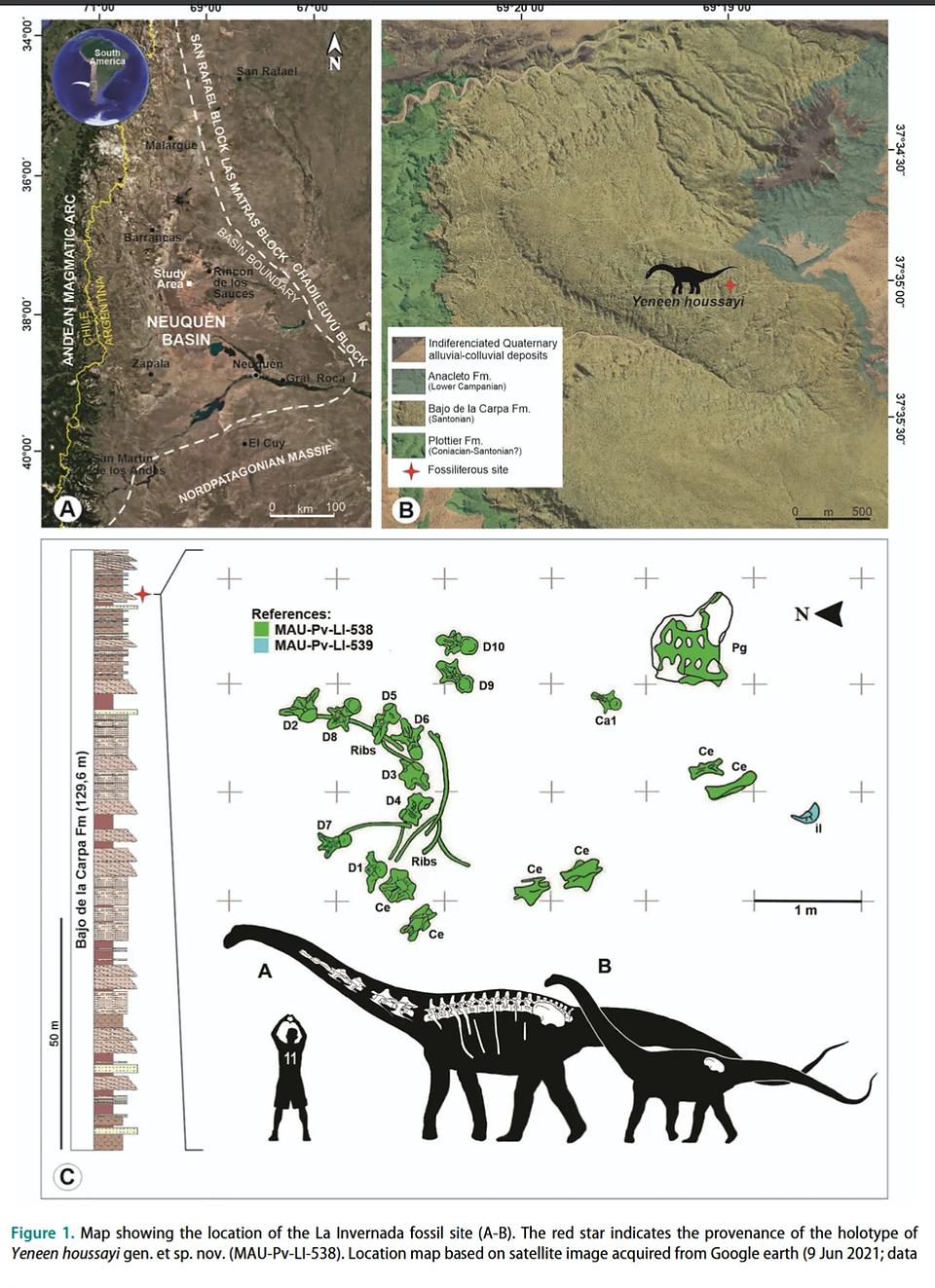
Yeneen is a relatively small titanosaurian sauropod dinosaur that lived during the Late Cretaceous period in what is now Argentina. Like all sauropods, it stood on four pillar-like legs, and used its long neck to reach vegetation. As a saltasauroid titanosaur, Yeneen likely had rows of osteoderms down its back.

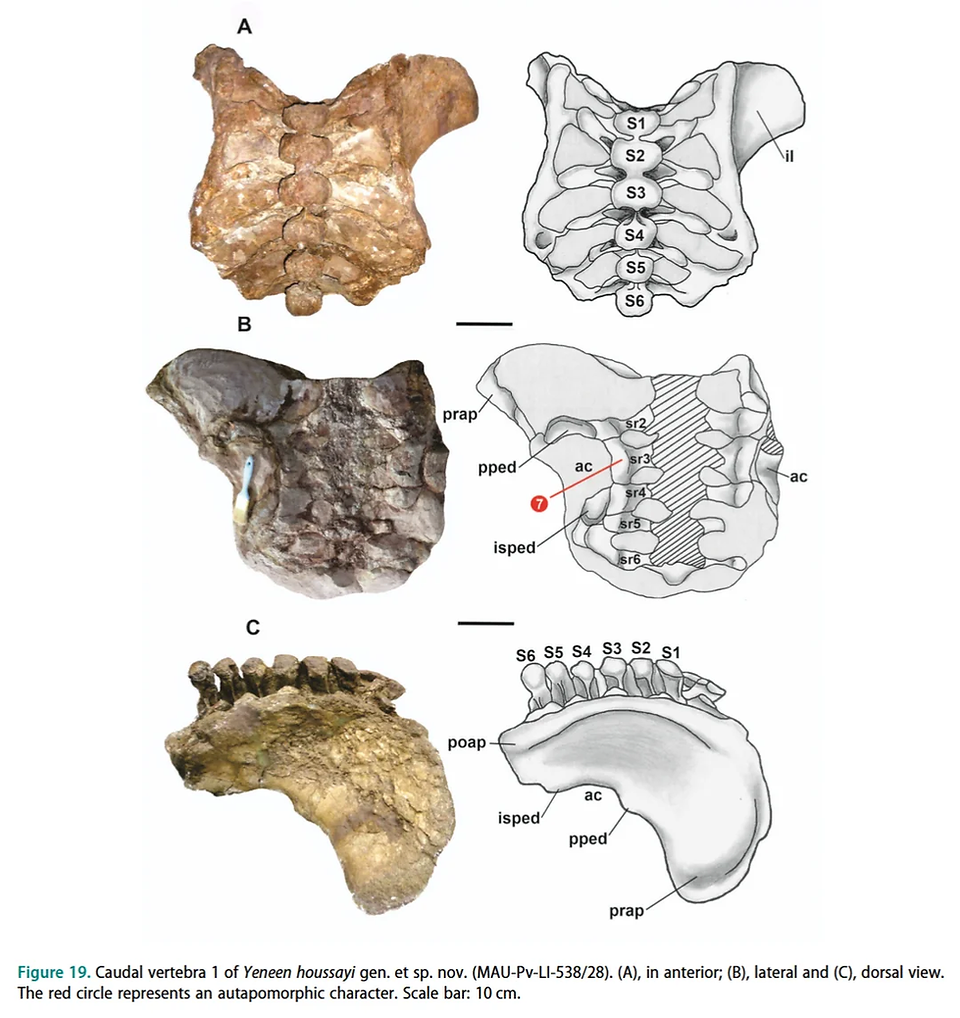
Abstract from paper: The fossil record of titanosaur sauropods for the Upper Cretaceous of the Neuquén Basin is remarkably extensive. However, for the Bajo de la Carpa Formation (Santonian) only five nominate species are recorded (Rinconsaurus caudamirus, Bonitasaura salgadoi, Traukutitan eocaudata, Overosaurus paradasorum, and Inawentu oslatus), the latter two coming from the Cerro Overo-La Invernada (CO-LI) area. Here we present a new titanosaur sauropod from La Invernada, Yeneen houssayi gen. et sp. nov. (MAU-Pv-LI-538). The new species is characterised by a series of distinctive features in dorsal, sacral and caudal vertebrae. Phylogenetic analysis indicates that Yeneen is closely related to Narambuenatitan and Overosaurus, as a basal member of an unnominated clade (called ‘Clade A’) of derived non-lithostrotian saltasauroids. The evidence provided by the Cerro Overo – La Invernada sauropod titanosaur fauna suggests that, during the Santonian, species diversity was relatively high and that at least two lineages coexisted: Collossosauria and Saltasauroidea. This finding makes the CO-LI area the one with the greatest diversity of titanosaurs for the Santonian of the Neuquén basin (as it is also for abelisaurid theropods), which makes it an exceptional area to understand the evolution of dinosaur faunas for this period.


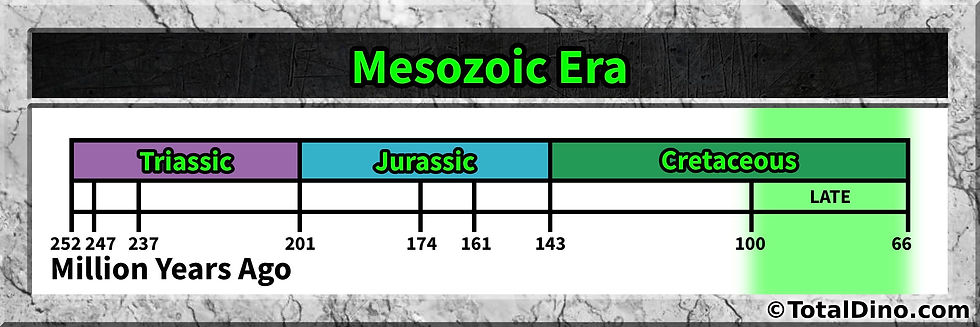
Yeneen is from the Late Cretaceous. The Cretaceous is the third and final geological period of the Mesozoic Era, with the Late Cretaceous making up roughly the second half of it, lasting from about 100 to 66 million years ago. It was a time of significant evolutionary change, with dinosaurs reaching their greatest diversity before the mass extinction at the end of the Cretaceous.
The Cretaceous was a period with a relatively warm climate, though the Late Cretaceous experienced a global cooling trend, caused by falling levels of carbon dioxide in the atmosphere. The continents were nearing their present positions, but high sea levels flooded low-lying regions, turning Europe into an archipelago, and forming the Western Interior Seaway in North America. These seas were home to a variety of marine reptiles, including mosasaurs and plesiosaurs, while pterosaurs and birds shared the skies.
On land, dinosaurs continued to thrive and diversify during the Late Cretaceous, producing many of the most well-known goups, including tyrannosaurs, hadrosaurs, and pachycephalosaurs. Established Cretaceous dinosaur clades like the ceratopsians, ankylosaurs, and dromaeosaurs continued to flourish. Sauropod species consisted almost exclusively of titanosaurs, which seemed to be confined to the Southern Hemisphere for much of the Late Cretaceous. Flowering plants and grasses diversified and spread, becoming the dominant flora similar to what we see today.
The Cretaceous (along with the Mesozoic) ended with the Cretaceous-Paleogene (K-Pg) extinction event, a large mass extinction in which many groups, including non-avian dinosaurs, pterosaurs, and large marine reptiles, died out. This event, likely triggered by an asteroid impact, is marked by the abrupt K-Pg boundary, a distinct geologic layer separating the Mesozoic and Cenozoic Eras. In its aftermath, mammals and avian dinosaurs rapidly diversified, becoming the dominant land animals of the Cenozoic Era.
Yeneen is a saltasauroid titanosaur. Saltasauroids are a clade of derived titanosaurs that thrived during the Late Cretaceous and are among the last and most specialized members of the sauropod lineage. They are primarily known from South America, though fossils have also been found in Asia and elsewhere. These sauropods tended to be smaller and more compact than their earlier relatives, with some species estimated to have been under 15 meters in length - small by sauropod standards. Despite their reduced size, they retained the characteristic long necks and tails of their lineage.
One of the most distinctive traits of saltasauroids is the presence of bony armor, or osteoderms, embedded in their skin - a rare feature among sauropods. This dermal armor suggests a possible evolutionary response to increased predation pressures during the Late Cretaceous. Their skeletons often show adaptations toward a more robust and stocky build, possibly indicating changes in locomotion or lifestyle compared to earlier titanosaurs. As one of the last surviving sauropod groups before the end-Cretaceous extinction, saltasauroids represent the final phase in the long evolutionary history of these giant herbivores.


Comments