

Chakisaurus
MEANING: Elder guanaco lizard
PERIOD: Late Cretaceous
CONTINENT: South America
Chakisaurus is a medium-sized elasmarian ornithopod dinosaur known from multiple partial skeletons belonging to individuals of different ages. Elasmaria is a diverse group of basal ornithopods known from the southern hemisphere. Chakisaurus is notable for having a downward curve in the base of its tail, a trait previously only seen in titanosaurs.

Abstract from paper: The aim of the present contribution is to describe the first ornithischian species from the Huincul Formation (Cenomanian-Turonian, Upper Cretaceous) at the Pueblo Blanco Natural Reserve, Río Negro province, Argentina. The new species, named as Chakisaurus nekul gen. et sp. nov., can be comfortably included among elasmarian ornithopods. The new species shows humeral anatomy that is congruent with smaller members of the clade (e.g. Anabisetia, Notohypsilophodon), and differs from larger taxa (e.g. Talenkauen, Mahuidacursor) which show humeral features probably related with graviportal habits, such as lack of shaft torsion and a distally located deltopectoral crest. This indicates that graviportal habits were probably acquired independently in elasmarians from other large-sized taxa, such as hadrosauroids. Caudal vertebrae of the new species also show a unique combination of characters shared with other elasmarians, which are absent in previously known ornithopods. These features indicate that some elasmarians had a protonic tail posture, which is unknown in other ornithischians and which was previously considered as unique to derived titanosaurian sauropods. The shape of transverse processes and neural spines of caudal vertebrae indicate that at least some elasmarians had improved cursorial habilities, that were convergently acquired by selected theropod clades.


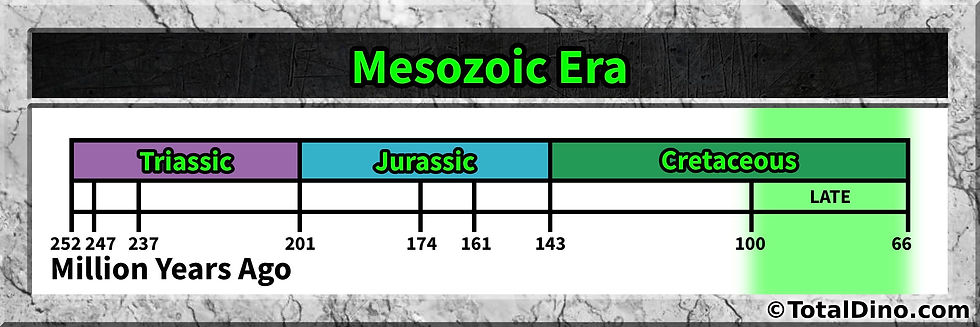
Chakisaurus is from the Late Cretaceous. The Cretaceous is the third and final geological period of the Mesozoic Era, with the Late Cretaceous making up roughly the second half of it, lasting from about 100 to 66 million years ago. It was a time of significant evolutionary change, with dinosaurs reaching their greatest diversity before the mass extinction at the end of the Cretaceous.
The Cretaceous was a period with a relatively warm climate, though the Late Cretaceous experienced a global cooling trend, caused by falling levels of carbon dioxide in the atmosphere. The continents were nearing their present positions, but high sea levels flooded low-lying regions, turning Europe into an archipelago, and forming the Western Interior Seaway in North America. These seas were home to a variety of marine reptiles, including mosasaurs and plesiosaurs, while pterosaurs and birds shared the skies.
On land, dinosaurs continued to thrive and diversify during the Late Cretaceous, producing many of the most well-known goups, including tyrannosaurs, hadrosaurs, and pachycephalosaurs. Established Cretaceous dinosaur clades like the ceratopsians, ankylosaurs, and dromaeosaurs continued to flourish. Sauropod species consisted almost exclusively of titanosaurs, which seemed to be confined to the Southern Hemisphere for much of the Late Cretaceous. Flowering plants and grasses diversified and spread, becoming the dominant flora similar to what we see today.
The Cretaceous (along with the Mesozoic) ended with the Cretaceous-Paleogene (K-Pg) extinction event, a large mass extinction in which many groups, including non-avian dinosaurs, pterosaurs, and large marine reptiles, died out. This event, likely triggered by an asteroid impact, is marked by the abrupt K-Pg boundary, a distinct geologic layer separating the Mesozoic and Cenozoic Eras. In its aftermath, mammals and avian dinosaurs rapidly diversified, becoming the dominant land animals of the Cenozoic Era.
Chakisaurus is an elasmarian. Elasmaria is a group of basal ornithopod dinosaurs primarily known from the Cretaceous of the Southern Hemisphere, especially South America, Australia, and Antarctica. These dinosaurs were small to medium-sized herbivores that retained primitive features compared to their more derived relatives, like the hadrosaurs. Typically, elasmarian ornithopods were lightly built and bipedal, with slender limbs and long tails, adaptations that likely helped them maneuver quickly through their environments to escape predators.
Fossil evidence shows that elasmarians thrived in high-latitude regions during the Cretaceous, suggesting they were adaptable to a range of climates, including cooler polar conditions. Unlike the later, larger ornithopods, they did not develop complex tooth batteries but instead retained simpler dentitions suited for processing softer vegetation. This group highlights the regional diversification of basal ornithopods in Gondwana and offers important clues about how these dinosaurs evolved and adapted away from their Northern Hemisphere relatives.


Comments