

Changzhousaurus
Updated: Jun 28
MEANING: Changzhou lizard
PERIOD: Early Cretaceous
CONTINENT: Asia
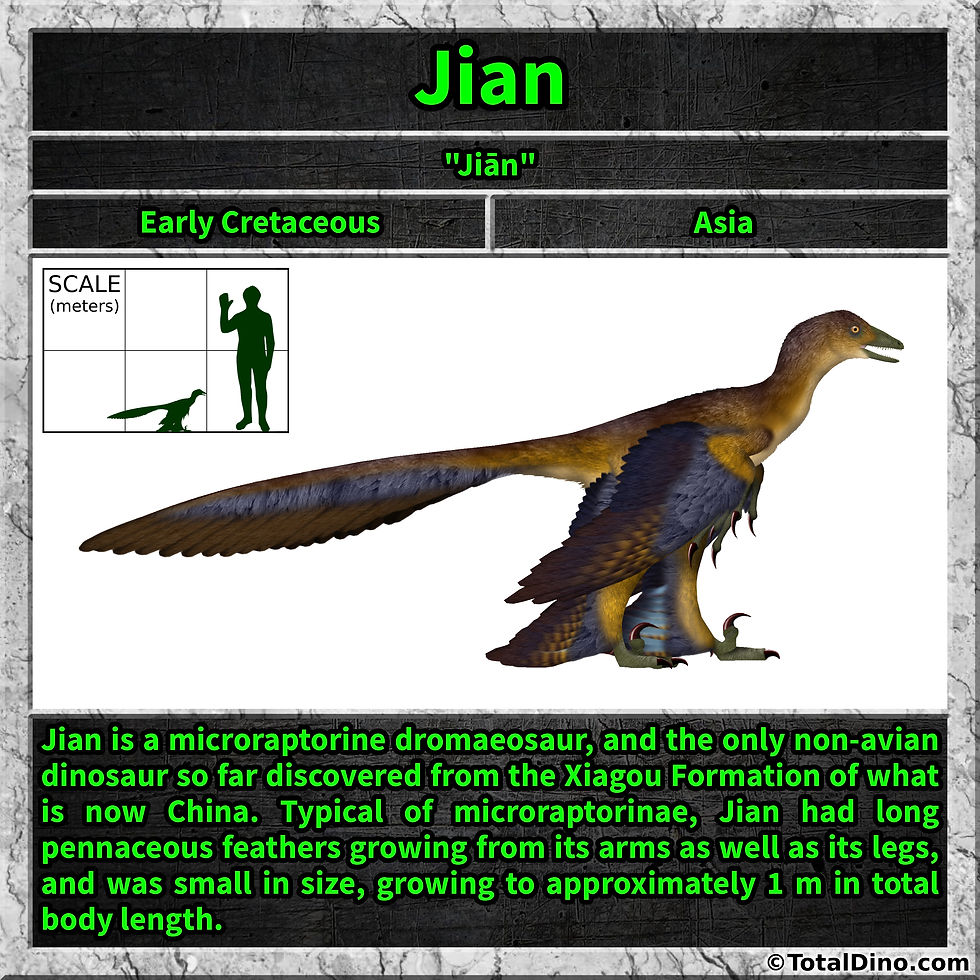
Changzhousaurus is a paravian theropod dinosaur, though more specific affinities are unclear, showing derived traits of both troodontidae and dromaeosauridae. It was very small, reaching about a third of a meter in body length. Fossil remains preserve a tail-fan similar to a peacock's, and long pennaceous feathers forming wings on the forelimbs and legs.

Abstract from paper: Recent discoveries of early-diverging pennaraptoran fossils have shed light on the origin of birds and, in particular, the evolution of defining avian features such as pennaceous feathers and flight capability. Here I report a new pennaraptoran dinosaur based on a fossil recovered from the Lower Cretaceous Jiufotang Formation of western Liaoning, China. Despite exhibiting a combination of derived features observed across distinct pennaraptoran lineages, this new taxon is likely an earlydiverging deinonychosaurian. Most notably, it possesses exceptional plumage characteristics: it represents the first known early-diverging pennaraptoran to bear both large pedal feathers and highly elongated rectrices; these elongated rectrices are substantially more abundant than those of other earlydiverging pennaraptorans, bearing a superficial resemblance to the tail plumes of peacocks; and its wing feathers form the proportionally largest feathered wings among non-avialan pennaraptorans—even with relatively short bony forelimbs—indicating a decoupling of forelimb skeletal length and feathered wing surface area. This discovery underscores the complexity of early pennaraptoran evolution and raises several conceptual and methodological issues in pennaraptoran research. These issues include how to recover a robust pennaraptoran phylogeny, how to infer the aerial behavior and habitat ecology of earlydiverging pennaraptorans, and how to define feathers and birds. I briefly address these issues in this paper.
Changzhousaurus is from the Early Cretaceous. The Cretaceous is the third and final geological period of the Mesozoic Era, with the Early Cretaceous making up roughly the first half, lasting from about 143 to 100 million years ago. The poles were ice-free, due to the relatively warm climate, and forests extended into high latitudes. The continued breakup of the continents created new coastlines and isolated landmasses, influencing the evolution of distinct dinosaur faunas.
It was a time of transition, as many groups of animals and plants began to take on more modern forms while others declined or disappeared. Pterosaurs continued to thrive, though early birds were becoming more diverse and widespread. Mammals remained small but adapted to a variety of ecological niches. In the oceans, ichthyosaurs and plesiosaurs were common, and early mosasaurs began to appear.
Dinosaurs remained the dominant land animals, with groups like iguanodontians, spinosaurids, and carcharodontosaurids rising to prominence. While sauropods declined in some regions, they remained abundant in the Southern Hemisphere. The first true ceratopsians appeared, and ankylosaurs replaced stegosaurs in their niche. Dromaeosaurs and other small theropods diversified. During this time, the first flowering plants evolved, gradually changing global ecosystems by providing new food sources for herbivores.

Changzhousaurus is a paravian. The evolution of birds began in the Jurassic Period, with the earliest birds derived from a clade of theropod dinosaurs named Paraves. The Archaeopteryx has famously been known as the first example of a bird for over a century, and this concept has been fine-tuned as better understanding of evolution has developed in recent decades.
Like other theropods, all paravians are bipedal, walking on their two hind legs. Most of the earliest groups were carnivorous, though some smaller species are known to have been omnivores. Paravians generally have long, winged forelimbs, though these have become smaller in many flightless species. The wings usually bore three large, flexible, clawed fingers in early forms. Over time, the fingers became fused and stiffened in some lineages, and the claws reduced or lost. An increasingly asymmetric wrist joint allowed the forelimbs to elongate and an elaboration of their plumage eventually allowed the evolution of flapping flight possible.
Birds, as we know them today, are the only surviving lineage of dinosaurs. As these early paravian dinosaurs continued to evolve through the Late Jurassic and into the Cretaceous, they developed lighter skeletons, improved respiratory systems, and more specialized feathers, all of which contributed to better aerial capabilities. The classic features we associate with modern birds - beaks, powerful flight muscles, and highly refined feathers - gradually emerged over millions of years. By the end of the Mesozoic, true birds had diversified into a wide range of ecological roles, from fish hunters to seed eaters. While most dinosaur lineages vanished in the Cretaceous-Paleogene extinction event, this small, feathered group managed to survive and radiate into one of the most successful vertebrate clades alive today.



Comments