

Diuqin
MEANING: Bird of prey
PERIOD: Late Cretaceous
CONTINENT: South America
Diuqin is an unenlagiine dinosaur from the Late Cretaceous of what is now Argentina. Like other dromaeosaurs, unenlagiines were covered in feathers, carnivorous, and had the large claw on the inner toe of each foot. Unique to unenlagiines is their elongated snout, suggesting a piscivorous diet. Diuqin was a medium-sized unenlagiine, at about 4 m in length.

Abstract from paper: Unenlagiine paravians are among the most relevant Gondwanan theropod dinosaur clades for understanding the origin of birds, yet their fossil record remains incomplete, with most taxa being represented by fragmentary material and/or separated by lengthy temporal gaps, frustrating attempts to characterize unenlagiine evolution.
Here we describe Diuqin lechiguanae gen. et sp. nov., a new unenlagiine taxon from the Upper Cretaceous (Santonian) Bajo de la Carpa Formation of the Neuquén Basin of Neuquén Province in northern Patagonia, Argentina that fills a substantial stratigraphic gap in the fossil record of these theropods. Although known only from a very incomplete postcranial skeleton, the preserved bones of Diuqin differ from corresponding elements in other unenlagiines, justifying the erection of the new taxon. Moreover, in several morphological aspects, the humerus of Diuqin appears intermediate between those of geologically older unenlagiines from the Neuquén Basin (e.g., Unenlagia spp. from the Turonian–Coniacian Portezuelo Formation) and that of the stratigraphically younger, larger-bodied Austroraptor cabazai from the Campanian–Maastrichtian Allen Formation. Consequently, the morphology of the new taxon appears to indicate a transitional stage in unenlagiine evolution. Phylogenetic analysis recovers Diuqin as a paravian with multiple plausible systematic positions, but the strongest affinity is with Unenlagiinae. The humerus of the new form exhibits subcircular punctures near its distal end that are interpreted as feeding traces most likely left by a conical-toothed crocodyliform, mammal, or theropod, the latter potentially corresponding to a megaraptorid or another unenlagiine individual. Thus, in addition to filling important morphological and temporal gaps in unenlagiine evolutionary history, the new taxon also offers information relating to the paleoecology of these theropods.


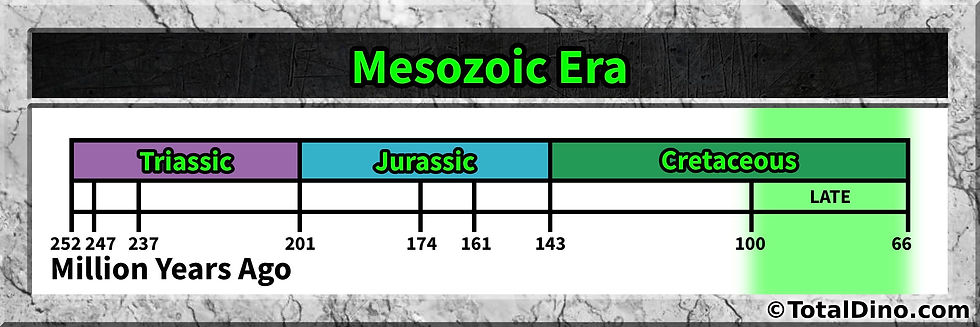
Diuqin is from the Late Cretaceous. The Cretaceous is the third and final geological period of the Mesozoic Era, with the Late Cretaceous making up roughly the second half of it, lasting from about 100 to 66 million years ago. It was a time of significant evolutionary change, with dinosaurs reaching their greatest diversity before the mass extinction at the end of the Cretaceous.
The Cretaceous was a period with a relatively warm climate, though the Late Cretaceous experienced a global cooling trend, caused by falling levels of carbon dioxide in the atmosphere. The continents were nearing their present positions, but high sea levels flooded low-lying regions, turning Europe into an archipelago, and forming the Western Interior Seaway in North America. These seas were home to a variety of marine reptiles, including mosasaurs and plesiosaurs, while pterosaurs and birds shared the skies.
On land, dinosaurs continued to thrive and diversify during the Late Cretaceous, producing many of the most well-known goups, including tyrannosaurs, hadrosaurs, and pachycephalosaurs. Established Cretaceous dinosaur clades like the ceratopsians, ankylosaurs, and dromaeosaurs continued to flourish. Sauropod species consisted almost exclusively of titanosaurs, which seemed to be confined to the Southern Hemisphere for much of the Late Cretaceous. Flowering plants and grasses diversified and spread, becoming the dominant flora similar to what we see today.
The Cretaceous (along with the Mesozoic) ended with the Cretaceous-Paleogene (K-Pg) extinction event, a large mass extinction in which many groups, including non-avian dinosaurs, pterosaurs, and large marine reptiles, died out. This event, likely triggered by an asteroid impact, is marked by the abrupt K-Pg boundary, a distinct geologic layer separating the Mesozoic and Cenozoic Eras. In its aftermath, mammals and avian dinosaurs rapidly diversified, becoming the dominant land animals of the Cenozoic Era.
Diuqin is an unenlagiid. Unenlagiidae is a family of small to medium-sized theropod dinosaurs within the larger group of dromaeosaurids - a group often associated with their birdlike anatomy and swift, predatory lifestyles. Unenlagiids were part of the Gondwanan radiation of dromaeosaurs, and they lived primarily in what is now South America during the Late Cretaceous Period. Like other dromaeosaurs, they had long, stiffened tails, sharp curved claws on their feet, and feathered bodies. However, unenlagiids also show features like elongated snouts and lightly built skulls, and in some cases, adaptations for increased agility suggesting semiaquatic lifestyles.
The distinct anatomy of unenlagiids compared to their northern cousins suggests that dromaeosaurs evolved in very different directions depending on where they lived.


bird of prey? that thing could bite me in half