

Hadrosaurus
MEANING: Bulky lizard
PERIOD: Late Cretaceous
CONTINENT: North America
Hadrosaurus is a basal hadrosaur from the Late Cretaceous period of what is now New Jersey. Although it lends its name to the derived hadrosaurine family of dinosaurs, studies show that it may not actually belong to this group. Hadrosaurus was a facultatively bipedal herbivore that grew to about 7 m in length and weighed around 3 t in total body mass.

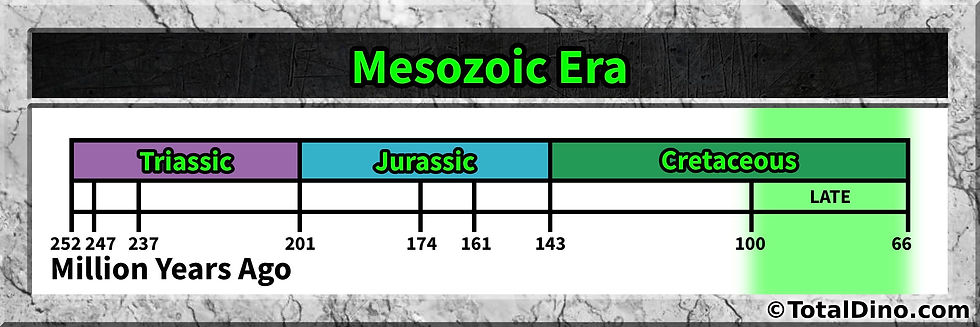
Hadrosaurus is from the Late Cretaceous. The Cretaceous is the third and final geological period of the Mesozoic Era, with the Late Cretaceous making up roughly the second half of it, lasting from about 100 to 66 million years ago. It was a time of significant evolutionary change, with dinosaurs reaching their greatest diversity before the mass extinction at the end of the Cretaceous.
The Cretaceous was a period with a relatively warm climate, though the Late Cretaceous experienced a global cooling trend, caused by falling levels of carbon dioxide in the atmosphere. The continents were nearing their present positions, but high sea levels flooded low-lying regions, turning Europe into an archipelago, and forming the Western Interior Seaway in North America. These seas were home to a variety of marine reptiles, including mosasaurs and plesiosaurs, while pterosaurs and birds shared the skies.
On land, dinosaurs continued to thrive and diversify during the Late Cretaceous, producing many of the most well-known groups, including tyrannosaurs, hadrosaurs, and pachycephalosaurs. Established Cretaceous dinosaur clades like the ceratopsians, ankylosaurs, and dromaeosaurs continued to flourish. Sauropod species consisted almost exclusively of titanosaurs, which seemed to be confined to the Southern Hemisphere for much of the Late Cretaceous. Flowering plants and grasses diversified and spread, becoming the dominant flora similar to what we see today.
The Cretaceous (along with the Mesozoic) ended with the Cretaceous-Paleogene (K-Pg) extinction event, a large mass extinction in which many groups, including non-avian dinosaurs, pterosaurs, and large marine reptiles, died out. This event, likely triggered by an asteroid impact, is marked by the abrupt K-Pg boundary, a distinct geologic layer separating the Mesozoic and Cenozoic Eras. In its aftermath, mammals and avian dinosaurs rapidly diversified, becoming the dominant land animals of the Cenozoic Era.
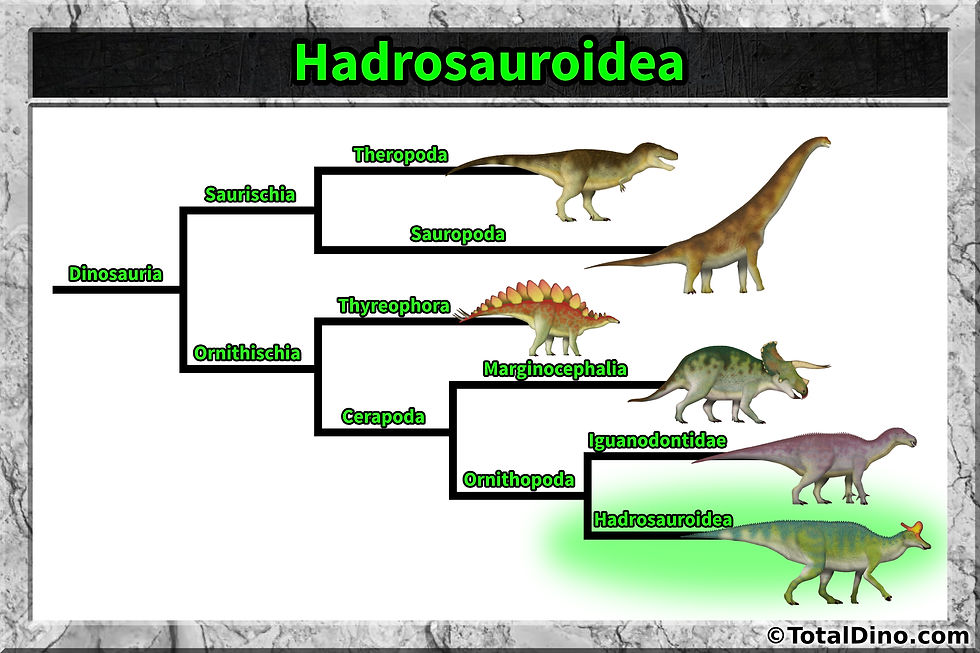
Hadrosaurus is a hadrosaur. Hadrosauroidea is the family of ornithopod dinosaurs that includes all species more derived than the Iguanodontidae, culminating in the highly specialized hadrosaurids. While the derived hardosaurs flourished in the Late Cretaceous, hadrosauroidea also includes a wide range of earlier, more generalized herbivores. These basal hadrosauroids retained many primitive traits, such as narrower snouts, less complex dental batteries, and a more variable mix of bipedal and quadrupedal locomotion.
Basal hadrosauroids were widespread, particularly during the Early and mid-Cretaceous, and are known from Asia, Europe, and North America. They typically inhabited floodplains and forested environments, where their well-developed chewing mechanisms and flexible limbs allowed them to browse on a wide range of plant material. These dinosaurs were often mid-sized and lightly built, with adaptations suggesting they could move efficiently on two legs but may have dropped to all fours while feeding. Hadrosauroids represent a crucial stage in ornithopod evolution, combining efficient herbivory, social behavior, and locomotor versatility in a lineage that would go on to become one of the most successful herbivorous groups of the Cretaceous.


Comments