

Kayrasaurus
Updated: 3 days ago
MEANING: Kayra lizard
PERIOD: Early Cretaceous
CONTINENT: Asia
Kayrasaurus is a therizinosaurian dinosaur that lived during the Early Cretaceous period in what is now China. At an estimated 3.6 m in total body length, it is the largest therizinosaur known from the Jehol Biota. Like other therizinosaurs, Kayrasaurus was a bipedal herbivore with large curved claws on each hand.

Abstract from paper: Therizinosauria is a highly specialized clade of maniraptoran theropods, notable for a suite of unusual traits in late-branching taxa. These paradoxical anatomical features contributed to the complex taxonomic history of the clade, which remained unresolved until the discovery of early branching taxa. Here, we describe a new early branching species, Kayrasaurus changliensis, based on a nearly complete, skeletally immature specimen (IVPP V 18597) recovered from the Lower Cretaceous Yixian Formation of western Liaoning, China. This taxon is notably larger than other penecontemporaneous Jehol therizinosaurians (at least 1.6 times larger than the secondlargest taxon, Beipiaosaurus inexpectus) and exhibits a unique combination of features (e.g. extremely small and densely packed teeth, cervical centra markedly longer than dorsal centra, and a dorsally extended ‘lip’ on manual ungual IV). We evaluate the phylogenetic position of K. changliensis using an expanded dataset with increased character and taxon sampling. Our results allow us to revise the diagnosis of B. inexpectus and provide new insights into therizinosaurian evolution, provisionally recovering two subclades within Therizinosauridae that are differentiated by their manual ungual morphology. By integrating morphological traits, body mass estimates, and biomechanical data, we infer the possibility of at least two distinct ecological niches among Jehol therizinosaurians. One ecological group, represented by B. inexpectus and possibly K. changliensis, exhibits features indicative of enhanced bite force and a more robust, less cursorial body plan. In contrast, Jianchangosaurus yixianensis and Lingyuanosaurus sihedangensis display traits associated with greater cursoriality and a reliance on forelimb-based foraging. Kayrasaurus changliensis, together with the results of our phylogenetic analysis, provides new insights into the morphological evolution and ecological adaptations of therizinosaurians in the Jehol Biota. However, further analyses and the discovery of more complete, well-preserved specimens are essential to rigorously test and refine these hypotheses.
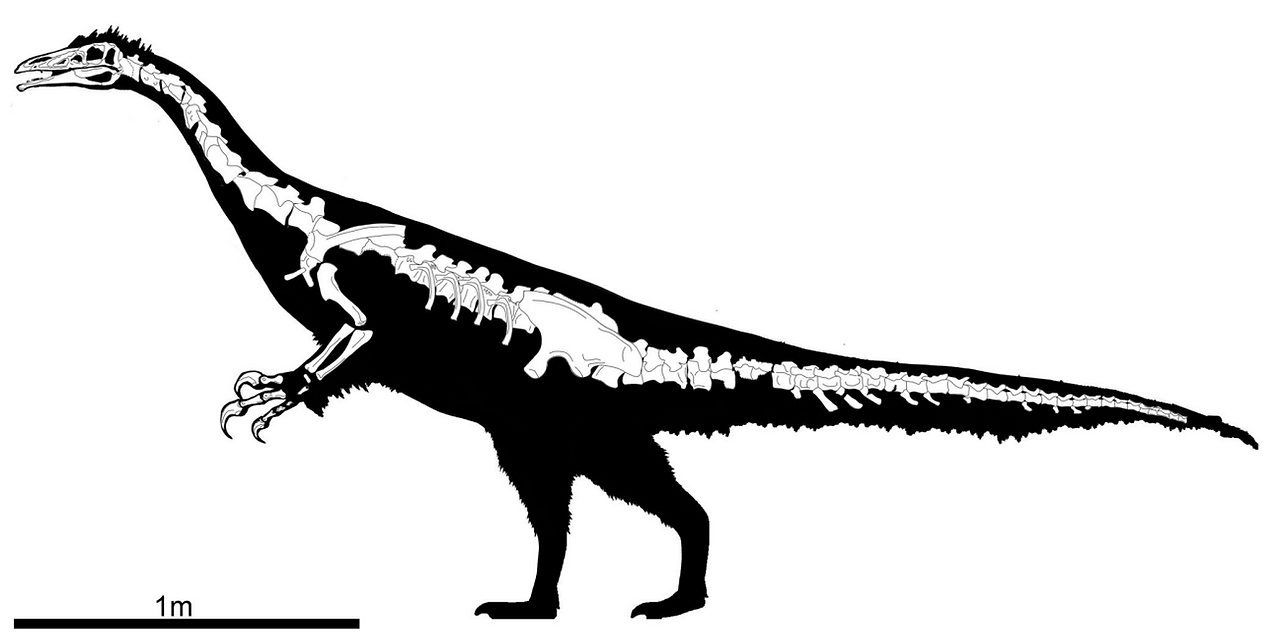


Kayrasaurus is from the Early Cretaceous. The Cretaceous is the third and final geological period of the Mesozoic Era, with the Early Cretaceous making up roughly the first half, lasting from about 143 to 100 million years ago. The poles were ice-free, due to the relatively warm climate, and forests extended into high latitudes. The continued breakup of the continents created new coastlines and isolated landmasses, influencing the evolution of distinct dinosaur faunas.
It was a time of transition, as many groups of animals and plants began to take on more modern forms while others declined or disappeared. Pterosaurs continued to thrive, though early birds were becoming more diverse and widespread. Mammals remained small but adapted to a variety of ecological niches. In the oceans, ichthyosaurs and plesiosaurs were common, and early mosasaurs began to appear.
Dinosaurs remained the dominant land animals, with groups like iguanodontians, spinosaurids, and carcharodontosaurids rising to prominence. While sauropods declined in some regions, they remained abundant in the Southern Hemisphere. The first true ceratopsians appeared, and ankylosaurs replaced stegosaurs in their niche. Dromaeosaurs and other small theropods diversified. During this time, the first flowering plants evolved, gradually changing global ecosystems by providing new food sources for herbivores.

Kayrasaurus is a therizinosaur. Therizinosauria is a family of large herbivorous theropod dinosaurs from the Middle Jurassic to Late Cretaceous deposits of Europe, Asia, and North America. They spanned a large range of sizes, from the Jianchangosaurus at about 2 m in length, to the 10 m long Therizinosaurus.
Therizinosaurs had a very distinctive set of characteristics. Their long necks, wide torsos, and hind four-toed feet resembled those of basal sauropodomorph dinosaurs. Among the most striking characteristics of therizinosaurs are the enormous claws on their hands, which reached lengths of around one meter in Therizinosaurus. The wide range of motion in the forelimbs also supports the idea that they were mainly herbivorous. They may have used their long reach and strongly curved claws to grasp and shear leafy branches. Skin impressions from Beipiaosaurus indicate that therizinosaurs were covered with a coat of primitive, down-like feathers, as well as longer, simpler, quill-like feathers that may have been used in display.


Comments