

Kryptohadros
Updated: Mar 3
MEANING: Hidden hadrosauroid
PERIOD: Late Cretaceous
CONTINENT: Europe
Kryptohadros is a hadrosauroid dinosaur that lived during the Late Cretaceous period in what is now Romania. During the Late Cretaceous, Europe was an island archipelago inhabited by a number of known non-hadrosaur hadrosauroids. The discovery of Kryptohadros established a new clade of these dinosaurs, named Telmatosauridae.

Abstract from paper: We report the discovery of an associated incomplete hadrosauroid skeleton with cranial and postcranial elements from a new Maastrichtian (Upper Cretaceous) vertebrate site (Fântânele-3) north-west of Vălioara village in the westernmost part of the Hațeg Basin (Transylvania, Romania), from continental deposits of the Densuș-Ciula Formation. This hadrosauroid material is described here as a new taxon, Kryptohadros kallaiae gen. et sp. nov., based on one autapomorphic character of the dentary, two local autapomorphies of the surangular, as well as a unique combination of characters. It represents the second non-hadrosaurid hadrosauroid known from the Hațeg region besides Telmatosaurus transsylvanicus, a historical taxon for which we also provide a revised diagnosis and an updated list of securely referred specimens. The identification of Kryptohadros shows that basal hadrosauroids were more diverse during the latest Cretaceous in this area than previously thought. Furthermore, our phylogenetic analyses reveal particularly close relationships between all currently known Late Cretaceous south-eastern European hadrosauroids (Telmatosaurus, Tethyshadros and Kryptohadros) that belong to a newly recognized small endemic clade, Telmatosauridae. In addition, these analyses identify several different hadrosauroid evolutionary lineages present within the Late Cretaceous European Archipelago, and suggest that at least six other dispersal events took place between the Albian and the Maastrichtian from Asia towards North America and/or Europe, besides the arrival of the ancestors of Telmatosauridae before the Campanian. The absence of certain later-arriving European hadrosauroid lineages from the faunas of the south-eastern European islands supports earlier hypotheses that propose a direct migration route during the latest Cretaceous between Asia and the south-western European islands, circumventing south-eastern Europe.


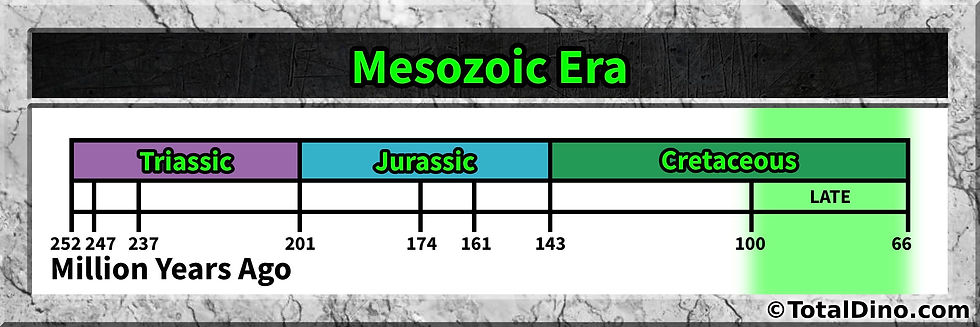
Kryptohadros is from the Late Cretaceous. The Cretaceous is the third and final geological period of the Mesozoic Era, with the Late Cretaceous making up roughly the second half of it, lasting from about 100 to 66 million years ago. It was a time of significant evolutionary change, with dinosaurs reaching their greatest diversity before the mass extinction at the end of the Cretaceous.
The Cretaceous was a period with a relatively warm climate, though the Late Cretaceous experienced a global cooling trend, caused by falling levels of carbon dioxide in the atmosphere. The continents were nearing their present positions, but high sea levels flooded low-lying regions, turning Europe into an archipelago, and forming the Western Interior Seaway in North America. These seas were home to a variety of marine reptiles, including mosasaurs and plesiosaurs, while pterosaurs and birds shared the skies.
On land, dinosaurs continued to thrive and diversify during the Late Cretaceous, producing many of the most well-known goups, including tyrannosaurs, hadrosaurs, and pachycephalosaurs. Established Cretaceous dinosaur clades like the ceratopsians, ankylosaurs, and dromaeosaurs continued to flourish. Sauropod species consisted almost exclusively of titanosaurs, which seemed to be confined to the Southern Hemisphere for much of the Late Cretaceous. Flowering plants and grasses diversified and spread, becoming the dominant flora similar to what we see today.
The Cretaceous (along with the Mesozoic) ended with the Cretaceous-Paleogene (K-Pg) extinction event, a large mass extinction in which many groups, including non-avian dinosaurs, pterosaurs, and large marine reptiles, died out. This event, likely triggered by an asteroid impact, is marked by the abrupt K-Pg boundary, a distinct geologic layer separating the Mesozoic and Cenozoic Eras. In its aftermath, mammals and avian dinosaurs rapidly diversified, becoming the dominant land animals of the Cenozoic Era.
Kryptohadros is an iguanodontian. Iguanodontia was an important branch of the ornithopoda, a group of herbivorous dinosaurs that would become one of the most successful clades of the Cretaceous. These dinosaurs first appeared in the Late Jurassic as small bipedal grazers, but diversified through the Early Cretaceous, gradually increasing into larger more robust forms. While the more derived hadrosaurs of the Late Cretaceous became highly specialized for chewing tough plant material, basal iguanodontians retained a mix of primitive and advanced traits. They were among the first large-bodied ornithopods to spread widely across the Northern Hemisphere, with fossils found in Europe, North Africa, and Asia.
Early iguanodontians possessed powerful hind limbs for efficient bipedal movement but could also walk on all fours when foraging. One of their most distinctive features was their unique hand structure, which included a stiff, spike-like thumb that may have been used for defense or breaking apart tough vegetation. Although they lacked the fully developed dental batteries of later hadrosaurs, their teeth were already adapted for efficient plant processing, giving them an evolutionary advantage as herbivores. These adaptations laid the groundwork for the eventual dominance of hadrosaurs, which would expand into even more diverse habitats and continue to thrive until the end of the Cretaceous.


Comments