

Mesetasaurus
Updated: Sep 15
MEANING: Meseta de Artigas lizard
PERIOD: Late Cretaceous
CONTINENT: South America
Mesetasaurus is a titanosaurian sauropod dinosaur that lived during the Late Cretaceous period in what is now Uruguay. Like all sauropods, it stood on four pillar-like legs, using its long neck to reach the vegetation it fed on, counterbalanced by its long tail. Relatively small for a titanosaur, Mesetasaurus grew to approximately 10 m in length.

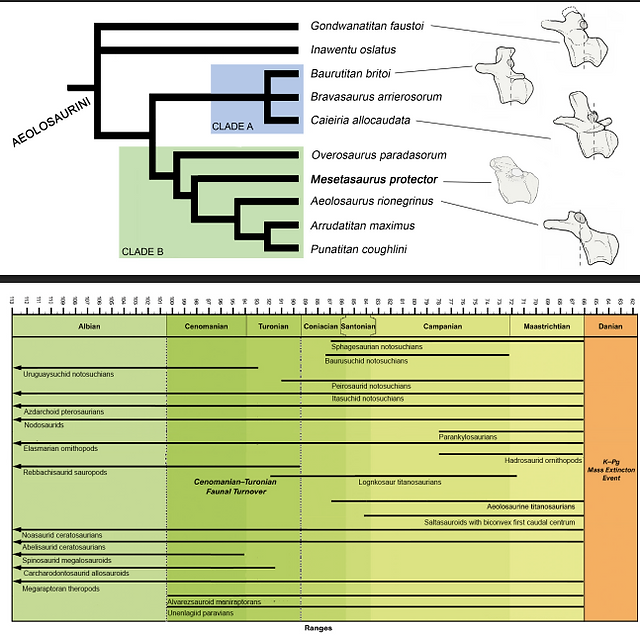
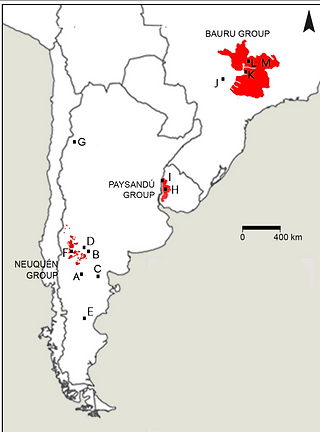
Abstract from paper: The Upper Cretaceous Guichón Formation (northwestern Uruguay) has yielded remains of notosuchian crocodyliforms, iguanodontian ornithopods, and saltasauroid titanosaurs. Two well-preserved sauropod caudal vertebrae from this unit are described herein from a new locality, Meseta de Artigas. The combination of synapomorphies allows the erection of a new taxon, Mesetasaurus protector gen. et sp. nov. It shares characters with members of the clade Aeolosaurini, such as strongly anteriorly inclined anterior face, neural arch placed at the level of the anterior border, anteriorly inclined neural spine, and long prezygapophyses. A phylogenetic analysis retrieves the new taxon deeply nested within Aeolosaurini. Given that Aeolosaurini is a Coniacian–Maastrichtian clade, this new sauropod provides additional evidence that suggests this age for the Guichón Formation. This is the second record of Aeolosaurini in Uruguay, and the second lineage of titanosaurian sauropods from the unit.


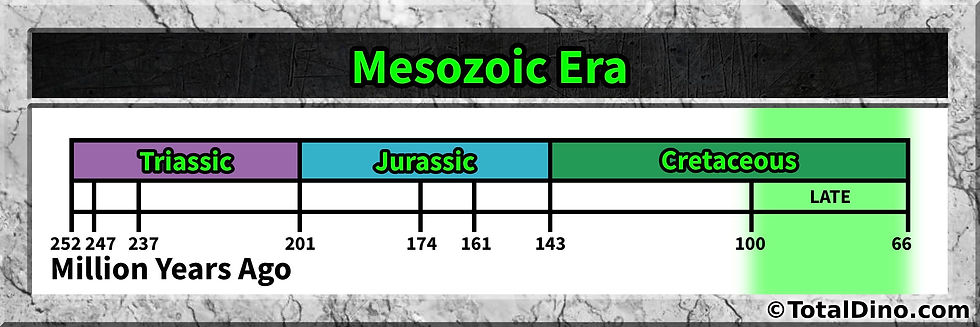
Mesetasaurus is from the Late Cretaceous. The Cretaceous is the third and final geological period of the Mesozoic Era, with the Late Cretaceous making up roughly the second half of it, lasting from about 100 to 66 million years ago. It was a time of significant evolutionary change, with dinosaurs reaching their greatest diversity before the mass extinction at the end of the Cretaceous.
The Cretaceous was a period with a relatively warm climate, though the Late Cretaceous experienced a global cooling trend, caused by falling levels of carbon dioxide in the atmosphere. The continents were nearing their present positions, but high sea levels flooded low-lying regions, turning Europe into an archipelago, and forming the Western Interior Seaway in North America. These seas were home to a variety of marine reptiles, including mosasaurs and plesiosaurs, while pterosaurs and birds shared the skies.
On land, dinosaurs continued to thrive and diversify during the Late Cretaceous, producing many of the most well-known goups, including tyrannosaurs, hadrosaurs, and pachycephalosaurs. Established Cretaceous dinosaur clades like the ceratopsians, ankylosaurs, and dromaeosaurs continued to flourish. Sauropod species consisted almost exclusively of titanosaurs, which seemed to be confined to the Southern Hemisphere for much of the Late Cretaceous. Flowering plants and grasses diversified and spread, becoming the dominant flora similar to what we see today.
The Cretaceous (along with the Mesozoic) ended with the Cretaceous-Paleogene (K-Pg) extinction event, a large mass extinction in which many groups, including non-avian dinosaurs, pterosaurs, and large marine reptiles, died out. This event, likely triggered by an asteroid impact, is marked by the abrupt K-Pg boundary, a distinct geologic layer separating the Mesozoic and Cenozoic Eras. In its aftermath, mammals and avian dinosaurs rapidly diversified, becoming the dominant land animals of the Cenozoic Era.
Mesetasaurus is a rinconsaurian titanosaur. Rinconsaurians are a group of derived titanosaurs that lived during the Late Cretaceous, primarily in South America. These dinosaurs were part of the later radiation of titanosaurs that flourished after the decline of other sauropod lineages, showcasing a wide range of body sizes and adaptations suited to the changing ecosystems of the Late Cretaceous.
Rinconsaurian titanosaurs are characterized by elongated neck vertebrae, slender limb bones, and distinctive tail structures, often with strongly curved anterior caudal vertebrae. These features may have contributed to a more flexible neck and tail, perhaps linked to specialized feeding or display behaviors. Compared to their massive lognkosaurian relatives, rinconsaurians were typically more lightly built, though still large by general dinosaur standards. Their fossils, found mainly in Argentina, help illustrate the evolutionary diversity within Titanosauria during its final chapters before the end-Cretaceous extinction.


Comments