

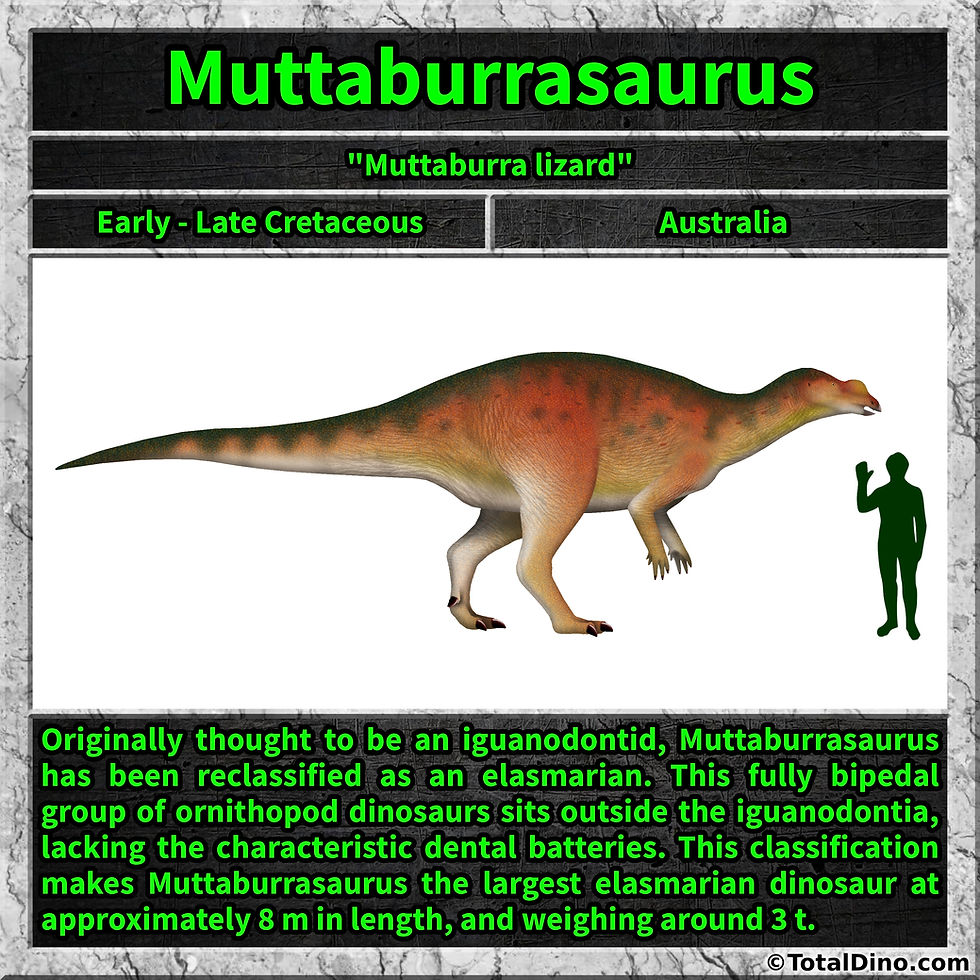
Muttaburrasaurus
MEANING: Muttaburra lizard
PERIOD: Early - Late Cretaceous
CONTINENT: Australia
Originally thought to be an iguanodontid, Muttaburrasaurus has been reclassified as an elasmarian. This fully bipedal group of ornithopod dinosaurs sits outside the iguanodontia, lacking the characteristic dental batteries. This classification makes Muttaburrasaurus the largest elasmarian dinosaur at approximately 8 m in length, and weighing around 3 t.
Muttaburrasaurus is from the Cretaceous. The Cretaceous is a geological period that lasted from about 145 to 66 million years ago. It is the third and final period of the Mesozoic Era, as well as the longest. At around 79 million years, it is the longest geological period of the entire Phanerozoic. The name is derived from the Latin creta, "chalk", which is abundant in the latter half of the period.
The Cretaceous was a period with a relatively warm climate, resulting in high eustatic sea levels that created numerous shallow inland seas. These oceans and seas were populated with now-extinct flora and fauna, while dinosaurs continued to dominate on land. The world was ice free, and forests extended to the poles. During this time, new groups of mammals and birds appeared. During the Early Cretaceous, flowering plants appeared and began to rapidly diversify, becoming the dominant group of plants across the Earth by the end of the Cretaceous, coincident with the decline and extinction of previously widespread gymnosperm groups.
The Cretaceous (along with the Mesozoic) ended with the Cretaceous–Paleogene extinction event, a large mass extinction in which many groups, including non-avian dinosaurs, pterosaurs, and large marine reptiles, died out. The end of the Cretaceous is defined by the abrupt Cretaceous–Paleogene boundary (K–Pg boundary), a geologic signature associated with the mass extinction that lies between the Mesozoic and Cenozoic Eras.

Muttaburrasaurus is an elasmarian. Elasmaria is a group of basal ornithopod dinosaurs primarily known from the Cretaceous of the Southern Hemisphere, especially South America, Australia, and Antarctica. These dinosaurs were small to medium-sized herbivores that retained primitive features compared to their more derived relatives, like the hadrosaurs. Typically, elasmarian ornithopods were lightly built and bipedal, with slender limbs and long tails, adaptations that likely helped them maneuver quickly through their environments to escape predators.
Fossil evidence shows that elasmarians thrived in high-latitude regions during the Cretaceous, suggesting they were adaptable to a range of climates, including cooler polar conditions. Unlike the later, larger ornithopods, they did not develop complex tooth batteries but instead retained simpler dentitions suited for processing softer vegetation. This group highlights the regional diversification of basal ornithopods in Gondwana and offers important clues about how these dinosaurs evolved and adapted away from their Northern Hemisphere relatives.


I like the old skull better. It's just the giant nose that stuck with me. Why don't you change this to that?