

Uriash
MEANING: Uriaș
PERIOD: Late Cretaceous
CONTINENT: Europe
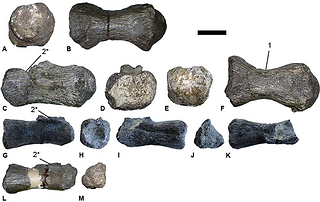
Uriash is a European titanosaur with evolutionary affinities to those from the southern continent of Gondwana. Its discovery strengthened the hypothesis that titanosaurs spread from the south in the Early Cretaceous. Small for a titanosaur, Uriash is one of the largest known from the European archipelago at about 10 m in length, and weighing 5-8 t in body mass.

Abstract from paper: The Hațeg Basin and surrounding areas in Transylvania, western Romania, have been a hotspot for research on vertebrate faunas of the Late Cretaceous European Archipelago. One of the historically earliest titanosaurian sauropod dinosaurs to be discovered, the ‘dwarfed’ species Magyarosaurus dacus comes from lower Maastrichtian deposits in this basin; however, this species has been neglected, with no modern treatment of its anatomy, taxonomy or phylogenetic affinities. Via detailed anatomical study of historical and undescribed remains, combined with archival data, we identify shared autapomorphies that link multiple partial skeletons. Our analysis of hundreds of specimens (including >20 monospecific assemblages) enables the stabilization of the type species Magyarosaurus dacus. We propose the presence of three additional, but only partly contemporaneous taxa – Paludititan nalatzensis, Petrustitan (‘Magyarosaurus’) hungaricus n. gen. and Uriash kadici n. gen. n. sp. (the latter being amongst the largest known sauropods of the Late Cretaceous European Archipelago). We present a new phylogenetic analysis (152 taxa scored for 570 characters), with implications for broader titanosaurian evolutionary relationships and biogeography: Magyarosaurus is recovered either as a member or a close relative of Saltasauridae; Paludititan has affinities with Lognkosauria, along with the contemporaneous Lohuecotitan; Petrustitan is most closely related to South American early diverging eutitanosaurian taxa; and Uriash also shares affinities with Gondwanan taxa. Our findings strengthen the hypothesis that latest Cretaceous European titanosaurs belonged to Gondwanan lineages that invaded the former area during the Barremian–Albian. We interpret the presence of body-size disparity as either evidence that large-bodied taxa were ecologically excluded from body-size reduction by competition with small-bodied titanosaurs, or that dwarfing occurred stratigraphically earlier among several lineages and the small-bodied titanosaurs on Hațeg Island are the descendants of existing dwarfed ancestors. Finally, we find no indication of a body size-related titanosaurian turnover in the uppermost Cretaceous of the Transylvanian area.



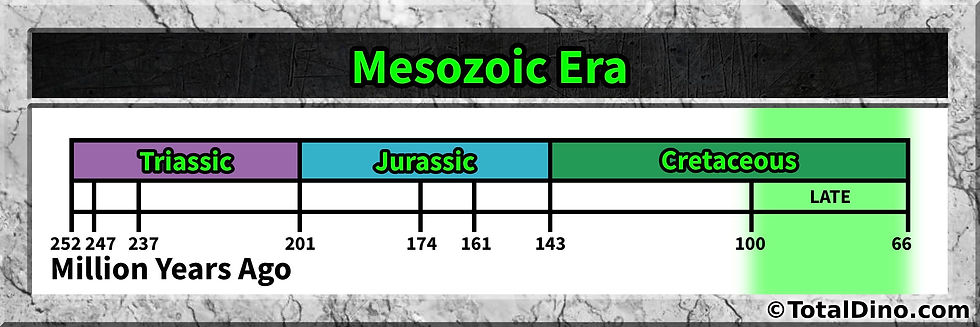
Uriash is from the Late Cretaceous. The Cretaceous is the third and final geological period of the Mesozoic Era, with the Late Cretaceous making up roughly the second half of it, lasting from about 100 to 66 million years ago. It was a time of significant evolutionary change, with dinosaurs reaching their greatest diversity before the mass extinction at the end of the Cretaceous.
The Cretaceous was a period with a relatively warm climate, though the Late Cretaceous experienced a global cooling trend, caused by falling levels of carbon dioxide in the atmosphere. The continents were nearing their present positions, but high sea levels flooded low-lying regions, turning Europe into an archipelago, and forming the Western Interior Seaway in North America. These seas were home to a variety of marine reptiles, including mosasaurs and plesiosaurs, while pterosaurs and birds shared the skies.
On land, dinosaurs continued to thrive and diversify during the Late Cretaceous, producing many of the most well-known goups, including tyrannosaurs, hadrosaurs, and pachycephalosaurs. Established Cretaceous dinosaur clades like the ceratopsians, ankylosaurs, and dromaeosaurs continued to flourish. Sauropod species consisted almost exclusively of titanosaurs, which seemed to be confined to the Southern Hemisphere for much of the Late Cretaceous. Flowering plants and grasses diversified and spread, becoming the dominant flora similar to what we see today.
The Cretaceous (along with the Mesozoic) ended with the Cretaceous-Paleogene (K-Pg) extinction event, a large mass extinction in which many groups, including non-avian dinosaurs, pterosaurs, and large marine reptiles, died out. This event, likely triggered by an asteroid impact, is marked by the abrupt K-Pg boundary, a distinct geologic layer separating the Mesozoic and Cenozoic Eras. In its aftermath, mammals and avian dinosaurs rapidly diversified, becoming the dominant land animals of the Cenozoic Era.
Uriash is a titanosaur. Titanosauria was a diverse and widespread group of sauropod dinosaurs that lived during the Cretaceous Period, especially flourishing in the Late Cretaceous. As the final major lineage of sauropods, they replaced older groups like the diplodocids and brachiosaurids that were more prominent in the Jurassic. Sauropods are herbivorous saurischian dinosaurs known for their long necks and immense size, and titanosaurs took this to the greatest extreme. Estimates vary, but the largest titanosaurs are estimated at upward of around 40 m long, and weighing 100 t in total body mass, or possibly even more. While this derived sauropod group included the largest animals ever to walk the earth, it is also notable for its diversity - titanosauria also includes some of the smallest sauropods.
Titanosaurs had a remarkable global distribution during the Cretaceous, with fossil remains discovered on nearly every continent, adapting to a wide range of environments. They were especially diverse and abundant in the Southern Hemisphere, where most of the larger species have been found. In contrast, titanosaurs are notably rare in North America, where they appear to have largely disappeared for much of the Late Cretaceous. This uneven distribution may reflect changing environmental conditions, or competition with other herbivores.
As with all other non-avian dinosaurs alive at the time, the titanosaurs died out in the Cretaceous-Paleogene extinction event, marking the end the long-lived sauropod lineage.


Comments