

Xenovenator
Updated: Jan 10
MEANING: Strange hunter
PERIOD: Late Cretaceous
CONTINENT: North America
Xenovenator is a relatively large troodontid dinosaur. It was covered in feathers and likely sported the sickle toe-claw typical of troodontids. Unique to Xenovenator was its domed head with a thickened skull roof, possibly used to for intraspecific combat similar to Pachycephalosaurs. Xenovenator grew to nearly 3 m in body length.

Abstract from paper: Dinosaurs repeatedly evolved adaptations for sexual selection over their 150-million year history, including adaptations for display and intraspecific combat. Adaptations for intraspecific combat have not previously been described in non-avian maniraptorans. We report a troodontid from the Campanian Cerro del Pueblo Formation of Coahuila, Mexico, showing a thickened and domed skull roof. The cranium is domed and bones are extremely thick, a morphology convergent on that of Pachycephalosauridae. Referred specimens show less thickening or doming, suggesting ontogenetic changes or perhaps sexual dimorphism. The holotype shows fusion of the frontal midline suture and tightly interdigitating sutures between skull bones, and a rugose skull roof. The specializations seen here suggest adaptation for intraspecific combat, specifically head-butting as hypothesized for pachycephalosaurids and pachyrhinosaurin ceratopsids. Repeated evolution of elaborate weapons and display features in the Cretaceous suggests that sexual selection became increasingly important in dinosaur evolution during the Cretaceous.


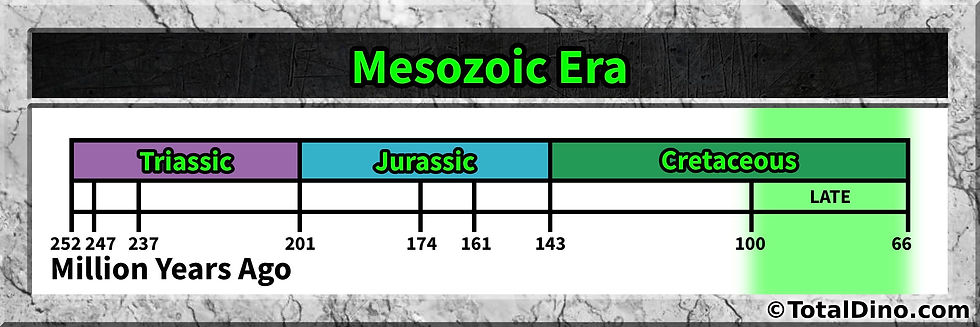
Xenovenator is from the Late Cretaceous. The Cretaceous is the third and final geological period of the Mesozoic Era, with the Late Cretaceous making up roughly the second half of it, lasting from about 100 to 66 million years ago. It was a time of significant evolutionary change, with dinosaurs reaching their greatest diversity before the mass extinction at the end of the Cretaceous.
The Cretaceous was a period with a relatively warm climate, though the Late Cretaceous experienced a global cooling trend, caused by falling levels of carbon dioxide in the atmosphere. The continents were nearing their present positions, but high sea levels flooded low-lying regions, turning Europe into an archipelago, and forming the Western Interior Seaway in North America. These seas were home to a variety of marine reptiles, including mosasaurs and plesiosaurs, while pterosaurs and birds shared the skies.
On land, dinosaurs continued to thrive and diversify during the Late Cretaceous, producing many of the most well-known goups, including tyrannosaurs, hadrosaurs, and pachycephalosaurs. Established Cretaceous dinosaur clades like the ceratopsians, ankylosaurs, and dromaeosaurs continued to flourish. Sauropod species consisted almost exclusively of titanosaurs, which seemed to be confined to the Southern Hemisphere for much of the Late Cretaceous. Flowering plants and grasses diversified and spread, becoming the dominant flora similar to what we see today.
The Cretaceous (along with the Mesozoic) ended with the Cretaceous-Paleogene (K-Pg) extinction event, a large mass extinction in which many groups, including non-avian dinosaurs, pterosaurs, and large marine reptiles, died out. This event, likely triggered by an asteroid impact, is marked by the abrupt K-Pg boundary, a distinct geologic layer separating the Mesozoic and Cenozoic Eras. In its aftermath, mammals and avian dinosaurs rapidly diversified, becoming the dominant land animals of the Cenozoic Era.
Xenovenator is a troodontid. Troodontidae is a family of small to medium-sized theropod dinosaurs best known for their keen senses and high intelligence, at least compared to other dinosaurs. Belonging to the group Paraves, they shared many features with both birds and dromaeosaurs. Troodontids typically had large eyes, suggesting excellent vision, and relatively large brains for their body size, which hints at complex behavior. They had long legs built for quick, agile movement and a distinctive sickle-shaped claw on the second toe of each foot, though this was generally less pronounced than in their dromaeosaur relatives.
Many genera are known only from teeth, and this has led to much debate and reclassification over the course of the history of paleontology. The oldest definitive troodontid is known from the Late Jurassic, and through the Cretaceous, they radiated across North America and Asia. Their teeth suggest that many species may have been omnivorous, able to eat a mix of plants and small animals. As members of the closely related groups that also gave rise to modern birds, troodontids are an important piece in understanding the broader story of dinosaur evolution, particularly the development of bird-like traits among theropods.


Xenocyon and Xenovenator have both Xeno in their names I wonder what else would be called Palaeo in their name 🦕 🦖 🐊